robots-5
Radar odometry
3260 papers • 126 benchmarks • 313 datasets
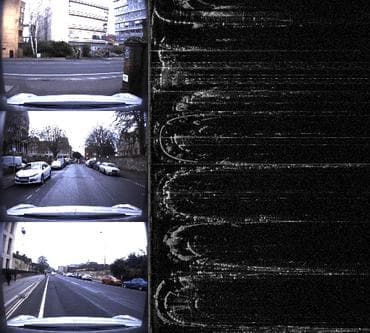
Radar odometry is the task of estimating the trajectory of the radar sensor, e.g. as presented in https://arxiv.org/abs/2105.01457. A well established performance metric was presented by Geiger (2012) - "Are we ready for autonomous driving? the KITTI vision benchmark suite"
(Image credit: Papersgraph)

Benchmarks
These leaderboards are used to track progress in radar-odometry-5
Trend
Dataset
Best Model
Actions

Oxford Radar RobotCar Dataset
Oxford Radar RobotCar Dataset
Libraries
iUse these libraries to find radar-odometry-5 models and implementations
Datasets
Subtasks
No subtasks available.
Most implemented papers
Under the Radar: Learning to Predict Robust Keypoints for Odometry Estimation and Metric Localisation in Radar
I. Posner, Dan Barnes•Tue Jan 28 2020
A self-supervised framework capable of full mapping and localisation with radar in urban environments, and is sensor agnostic and can be applied to most modalities.
130