Datasets
Explore thousands of machine learning datasets across various modalities and tasks
12463
Datasets
39
Modalities
3720
Tasks
12463 datasets results
Showing 15 datasets
MNIST
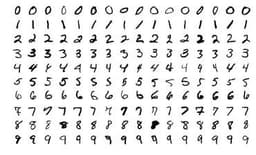
The MNIST database (Modified National Institute of Standards and Technology database) is a large collection of handwritten digits. It has a training set of 60,000 examples, and a test set of 10,000 examples. It is a subset of a larger NIST Special Database 3 (digits written by employees of the United States Census Bureau) and Special Database 1 (digits written by high school students) which contain monochrome images of handwritten digits. The digits have been size-normalized and centered in a fixed-size image. The original black and white (bilevel) images from NIST were size normalized to fit in a 20x20 pixel box while preserving their aspect ratio. The resulting images contain grey levels as a result of the anti-aliasing technique used by the normalization algorithm. the images were centered in a 28x28 image by computing the center of mass of the pixels, and translating the image so as to position this point at the center of the 28x28 field.
ImagesImage ClassificationSpeech Recognition+59 more
1
Papers
B
61
Benchmarks
CelebA
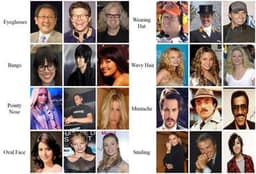
CelebFaces Attributes dataset contains 202,599 face images of the size 178×218 from 10,177 celebrities, each annotated with 40 binary labels indicating facial attributes like hair color, gender and age.
ImagesImage ClassificationImage Generation+18 more
1
Papers
B
20
Benchmarks
JFT-300M
JFT-300M is an internal Google dataset used for training image classification models. Images are labeled using an algorithm that uses complex mixture of raw web signals, connections between web-pages and user feedback. This results in over one billion labels for the 300M images (a single image can have multiple labels). Of the billion image labels, approximately 375M are selected via an algorithm that aims to maximize label precision of selected images.
ImagesImage Classification
1
Papers
B
1
Benchmarks
GLUE
General Language Understanding Evaluation (GLUE) benchmark is a collection of nine natural language understanding tasks, including single-sentence tasks CoLA and SST-2, similarity and paraphrasing tasks MRPC, STS-B and QQP, and natural language inference tasks MNLI, QNLI, RTE and WNLI.
TextsClassificationText Classification+12 more
1
Papers
B
14
Benchmarks
MultiNLI
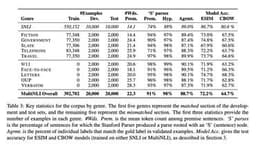
The Multi-Genre Natural Language Inference (MultiNLI) dataset has 433K sentence pairs. Its size and mode of collection are modeled closely like SNLI. MultiNLI offers ten distinct genres (Face-to-face, Telephone, 9/11, Travel, Letters, Oxford University Press, Slate, Verbatim, Goverment and Fiction) of written and spoken English data. There are matched dev/test sets which are derived from the same sources as those in the training set, and mismatched sets which do not closely resemble any seen at training time.
TextsText GenerationNatural Language Inference
1
Papers
B
2
Benchmarks
ImageNet
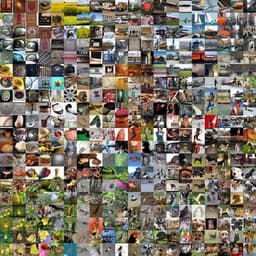
The ImageNet dataset contains 14,197,122 annotated images according to the WordNet hierarchy. Since 2010 the dataset is used in the ImageNet Large Scale Visual Recognition Challenge (ILSVRC), a benchmark in image classification and object detection. The publicly released dataset contains a set of manually annotated training images. A set of test images is also released, with the manual annotations withheld. ILSVRC annotations fall into one of two categories: (1) image-level annotation of a binary label for the presence or absence of an object class in the image, e.g., “there are cars in this image” but “there are no tigers,” and (2) object-level annotation of a tight bounding box and class label around an object instance in the image, e.g., “there is a screwdriver centered at position (20,25) with width of 50 pixels and height of 30 pixels”. The ImageNet project does not own the copyright of the images, therefore only thumbnails and URLs of images are provided.
ImagesImage ClassificationClassification+41 more
0
Papers
B
43
Benchmarks
Penn Treebank
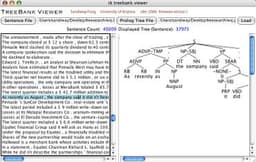
The English Penn Treebank (PTB) corpus, and in particular the section of the corpus corresponding to the articles of Wall Street Journal (WSJ), is one of the most known and used corpus for the evaluation of models for sequence labelling. The task consists of annotating each word with its Part-of-Speech tag. In the most common split of this corpus, sections from 0 to 18 are used for training (38 219 sentences, 912 344 tokens), sections from 19 to 21 are used for validation (5 527 sentences, 131 768 tokens), and sections from 22 to 24 are used for testing (5 462 sentences, 129 654 tokens). The corpus is also commonly used for character-level and word-level Language Modelling.
TextsLanguage ModellingOpen Information Extraction+8 more
1
Papers
B
10
Benchmarks
WikiText-103
The WikiText language modeling dataset is a collection of over 100 million tokens extracted from the set of verified Good and Featured articles on Wikipedia. The dataset is available under the Creative Commons Attribution-ShareAlike License.
TextsText GenerationLanguage Modelling
1
Papers
B
2
Benchmarks
LFW
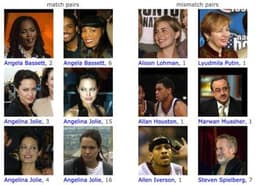
The LFW dataset contains 13,233 images of faces collected from the web. This dataset consists of the 5749 identities with 1680 people with two or more images. In the standard LFW evaluation protocol the verification accuracies are reported on 6000 face pairs.
Images3D Face ModellingFace Recognition+8 more
0
Papers
B
10
Benchmarks
WikiSQL
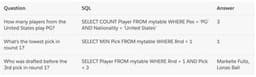
WikiSQL consists of a corpus of 87,726 hand-annotated SQL query and natural language question pairs. These SQL queries are further split into training (61,297 examples), development (9,145 examples) and test sets (17,284 examples). It can be used for natural language inference tasks related to relational databases.
TextsQuestion AnsweringSemantic Parsing+3 more
1
Papers
B
5
Benchmarks
OpenAI Gym
OpenAI Gym is a toolkit for developing and comparing reinforcement learning algorithms. It includes environment such as Algorithmic, Atari, Box2D, Classic Control, MuJoCo, Robotics, and Toy Text.
EnvironmentContinuous ControlOpenAI Gym
1
Papers
B
2
Benchmarks
WikiText-2
The WikiText language modeling dataset is a collection of over 100 million tokens extracted from the set of verified Good and Featured articles on Wikipedia. The dataset is available under the Creative Commons Attribution-ShareAlike License.
TextsText GenerationLanguage Modelling
1
Papers
B
2
Benchmarks
WikiLarge
WikiLarge comprise 359 test sentences, 2000 development sentences and 300k training sentences. Each source sentences in test set has 8 simplified references
TextsText SimplificationLexical Simplification
1
Papers
B
2
Benchmarks
Food-101
The Food-101 dataset consists of 101 food categories with 750 training and 250 test images per category, making a total of 101k images. The labels for the test images have been manually cleaned, while the training set contains some noise.
ImagesImage ClassificationClassification+14 more
1
Papers
B
16
Benchmarks
Fashion-MNIST
Fashion-MNIST is a dataset comprising of 28×28 grayscale images of 70,000 fashion products from 10 categories, with 7,000 images per category. The training set has 60,000 images and the test set has 10,000 images. Fashion-MNIST shares the same image size, data format and the structure of training and testing splits with the original MNIST.
ImagesImage ClassificationImage Generation+15 more
1
Papers
B
17
Benchmarks
Showing page 1 of 831 • 12,463 total datasets