3260 papers • 126 benchmarks • 313 datasets
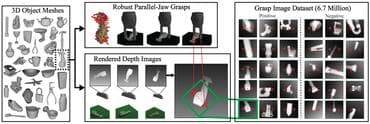
This task is composed of using Deep Learning to identify how best to grasp objects using robotic arms in different scenarios. This is a very complex task as it might involve dynamic environments and objects unknown to the network.
(Image credit: Papersgraph)

These leaderboards are used to track progress in robotic-grasping-21
Use these libraries to find robotic-grasping-21 models and implementations
A novel Generative Residual Convolutional Neural Network (GR-ConvNet) model that can generate robust antipodal grasps from n-channel input at real-time speeds (∼20ms) is proposed.
It is shown that a mild relaxation of the task and workspace constraints implicit in existing object grasping datasets can cause neural network based grasping algorithms to fail on even a simple block stacking task when executed under more realistic circumstances.
A robotic pick-and-place system that is capable of grasping and recognizing both known and novel objects in cluttered environments and that handles a wide range of object categories without needing any task-specific training data for novel objects is presented.
The generative model is able to synthesize high-quality human grasps, given only on a 3D object point cloud and achieves comparable performance for 3D hand reconstruction compared to state-of-the-art methods.
This work creates a novel RGB-D dataset, called Digital Twin Tracking Dataset (DTTD), to enable further research of the problem and extend potential solutions towards longer ranges and mm localization accuracy, and demonstrates that DTTD can help researchers develop future object tracking methods and analyze new challenges.
A deep learning architecture is proposed to predict graspable locations for robotic manipulation. It considers situations where no, one, or multiple object(s) are seen. By defining the learning problem to be classified with null hypothesis competition instead of regression, the deep neural network with red, green, blue and depth (RGB-D) image input predicts multiple grasp candidates for a single object or multiple objects, in a single shot. The method outperforms state-of-the-art approaches on the Cornell dataset with 96.0% and 96.1% accuracy on imagewise and objectwise splits, respectively. Evaluation on a multiobject dataset illustrates the generalization capability of the architecture. Grasping experiments achieve 96.0% grasp localization and 89.0% grasping success rates on a test set of household objects. The real-time process takes less than 0.25 s from image to plan.
An accurate, real-time approach to robotic grasp detection based on convolutional neural networks that outperforms state-of-the-art approaches by 14 percentage points and runs at 13 frames per second on a GPU.
PyRobot is a light-weight, high-level interface on top of ROS that provides a consistent set of hardware independent mid-level APIs to control different robots, and will reduce the entry barrier into robotics, and democratize robotics.
This work presents a convolutional neural network for estimating pixelwise object placement probabilities for a set of spatial relations from a single input image, and demonstrates the effectiveness of the method in reasoning about the best way to place objects to reproduce a spatial relation.
This work presents a robot system that follows unconstrained language instructions to pick and place arbitrary objects and effectively resolves ambiguities through dialogues and demonstrates the effectiveness of the method in understanding pick-and-place language instructions and sequentially composing them to solve tabletop manipulation tasks.
Adding a benchmark result helps the community track progress.