3260 papers • 126 benchmarks • 313 datasets
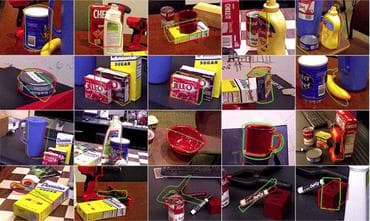
Image: Zeng et al
(Image credit: Papersgraph)

These leaderboards are used to track progress in 6d-pose-estimation-7
Use these libraries to find 6d-pose-estimation-7 models and implementations
The proposed method is able to robustly estimate the pose and size of unseen object instances in real environments while also achieving state-of-the-art performance on standard 6D pose estimation benchmarks.
This work introduces PoseCNN, a new Convolutional Neural Network for 6D object pose estimation, which is highly robust to occlusions, can handle symmetric objects, and provide accurate pose estimation using only color images as input.
DenseFusion is a generic framework for estimating 6D pose of a set of known objects from RGB-D images that processes the two data sources individually and uses a novel dense fusion network to extract pixel-wise dense feature embedding, from which the pose is estimated.
The core of the approach is that a set of surface points on target object model are designated as keypoints and then train a keypoint detector (KPD) to localize them and a PnP algorithm can recover the 6D pose according to the 2D-3D relationship of keypoints.
A novel pose estimation method that predicts the 3D coordinates of each object pixel without textured models, and a novel loss function, the transformer loss, is proposed to handle symmetric objects by guiding predictions to the closest symmetric pose.
This paper introduces a segmentation-driven 6D pose estimation framework where each visible part of the objects contributes a local pose prediction in the form of 2D keypoint locations and uses a predicted measure of confidence to combine these pose candidates into a robust set of 3D-to-2D correspondences.
Although the top-performing methods rely on RGB-D image channels, strong results were achieved when only RGB channels were used at both training and test time, and the photorealism of PBR images was demonstrated effective despite the augmentation.
A deep Hough voting network is proposed to detect 3D keypoints of objects and then estimate the 6D pose parameters within a least-squares fitting manner, which is a natural extension of 2D-keypoint approaches that successfully work on RGB based 6DoF estimation.
The proposed method, dubbed CosyPose, outperforms current state-of-the-art results for single-view and multi-view 6D object pose estimation by a large margin on two challenging benchmarks: the YCB-Video and T-LESS datasets.
EfficientPose is a new approach for 6D object pose estimation that achieves a new state-of-the-art accuracy of 97.35% in terms of the ADD(-S) metric on the widely-used 6D pose estimation benchmark dataset Linemod using RGB input, while still running end-to-end at over 27 FPS.
Adding a benchmark result helps the community track progress.