3260 papers • 126 benchmarks • 313 datasets
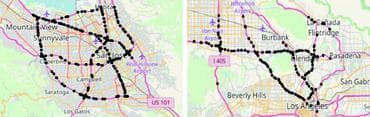
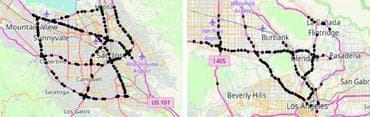
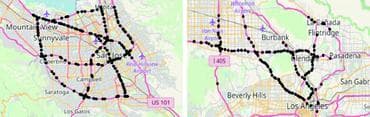
Traffic Prediction is a task that involves forecasting traffic conditions, such as the volume of vehicles and travel time, in a specific area or along a particular road. This task is important for optimizing transportation systems and reducing traffic congestion. ( Image credit: BaiduTraffic )
(Image credit: Papersgraph)

These leaderboards are used to track progress in traffic-prediction-4
Use these libraries to find traffic-prediction-4 models and implementations
This paper presents a general end-to-end approach to sequence learning that makes minimal assumptions on the sequence structure, and finds that reversing the order of the words in all source sentences improved the LSTM's performance markedly, because doing so introduced many short term dependencies between the source and the target sentence which made the optimization problem easier.
Diffusion Convolutional Recurrent Neural Network (DCRNN), a deep learning framework for traffic forecasting that incorporates both spatial and temporal dependency in the traffic flow and evaluates the framework on two real-world large scale road network traffic datasets and observes consistent improvement.
This paper proposes a novel graph neural network architecture, Graph WaveNet, for spatial-temporal graph modeling by developing a novel adaptive dependency matrix and learn it through node embedding, which can precisely capture the hidden spatial dependency in the data.
Experimental results on two real-world traffic prediction tasks demonstrate the superiority of GMAN, and in the 1 hour ahead prediction, GMAN outperforms state-of-the-art methods by up to 4% improvement in MAE measure.
A novel Spatial-Temporal Dynamic Network (STDN) is proposed, in which a flow gating mechanism is introduced to learn the dynamic similarity between locations, and a periodically shifted attention mechanism is designed to handle long-term periodic temporal shifting.
This work improves GWN by using better hyperparameters, adding connections that allow larger gradients to flow back to the early convolutional layers, and pretraining on an easier short-term traffic prediction task, and shows that ensembling separate models for short- and long-term predictions further improves performance.
A novel neural network architecture that conducts sample convolution and interaction for temporal modeling and forecasting, named SCINet, which is a recursive downsample-convolve-interact architecture that achieves significant forecasting accuracy improvements over both existing convolutional models and Transformer-based solutions across various real-world time series forecasting datasets.
It is argued that learning node-specific patterns is essential for traffic forecasting while the pre-defined graph is avoidable, and two adaptive modules for enhancing Graph Convolutional Network (GCN) with new capabilities are proposed.
Adding a benchmark result helps the community track progress.