3260 papers • 126 benchmarks • 313 datasets
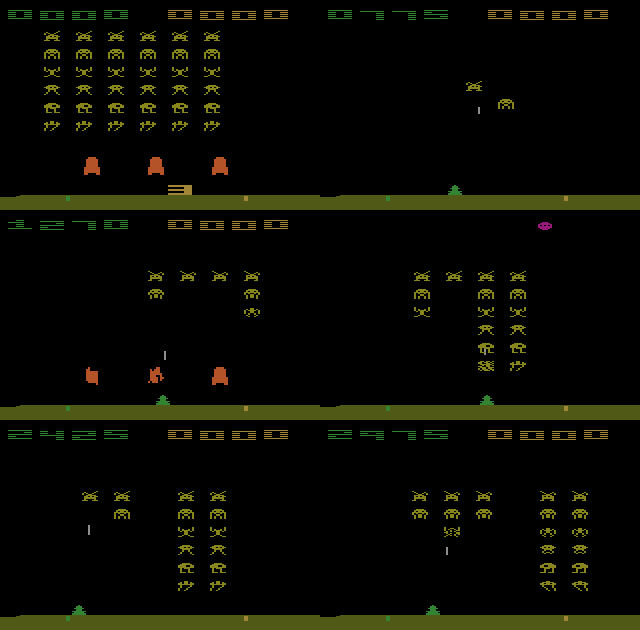
The Atari 2600 Games task (and dataset) involves training an agent to achieve high game scores. ( Image credit: Playing Atari with Deep Reinforcement Learning )
(Image credit: Papersgraph)

These leaderboards are used to track progress in video-games
Use these libraries to find video-games models and implementations
This work presents the first deep learning model to successfully learn control policies directly from high-dimensional sensory input using reinforcement learning, which outperforms all previous approaches on six of the games and surpasses a human expert on three of them.
This paper proposes a specific adaptation to the DQN algorithm and shows that the resulting algorithm not only reduces the observed overestimations, as hypothesized, but that this also leads to much better performance on several games.
A framework for prioritizing experience, so as to replay important transitions more frequently, and therefore learn more efficiently, in Deep Q-Networks, a reinforcement learning algorithm that achieved human-level performance across many Atari games.
This paper presents a new neural network architecture for model-free reinforcement learning that leads to better policy evaluation in the presence of many similar-valued actions and enables the RL agent to outperform the state-of-the-art on the Atari 2600 domain.
A conceptually simple and lightweight framework for deep reinforcement learning that uses asynchronous gradient descent for optimization of deep neural network controllers and shows that asynchronous actor-critic succeeds on a wide variety of continuous motor control problems as well as on a new task of navigating random 3D mazes using a visual input.
This paper examines six extensions to the DQN algorithm and empirically studies their combination, showing that the combination provides state-of-the-art performance on the Atari 2600 benchmark, both in terms of data efficiency and final performance.
A method for optimizing control policies, with guaranteed monotonic improvement, by making several approximations to the theoretically-justified scheme, called Trust Region Policy Optimization (TRPO).
This work explores the use of Evolution Strategies (ES), a class of black box optimization algorithms, as an alternative to popular MDP-based RL techniques such as Q-learning and Policy Gradients, and highlights several advantages of ES as a blackbox optimization technique.
This paper argues for the fundamental importance of the value distribution: the distribution of the random return received by a reinforcement learning agent, and designs a new algorithm which applies Bellman's equation to the learning of approximate value distributions.
Preliminary evidence that swapping convolution for CoordConv can improve models on a diverse set of tasks is shown, which works by giving convolution access to its own input coordinates through the use of extra coordinate channels without sacrificing the computational and parametric efficiency of ordinary convolution.
Adding a benchmark result helps the community track progress.