natural-language-processing
Topic coverage
3260 papers • 126 benchmarks • 313 datasets
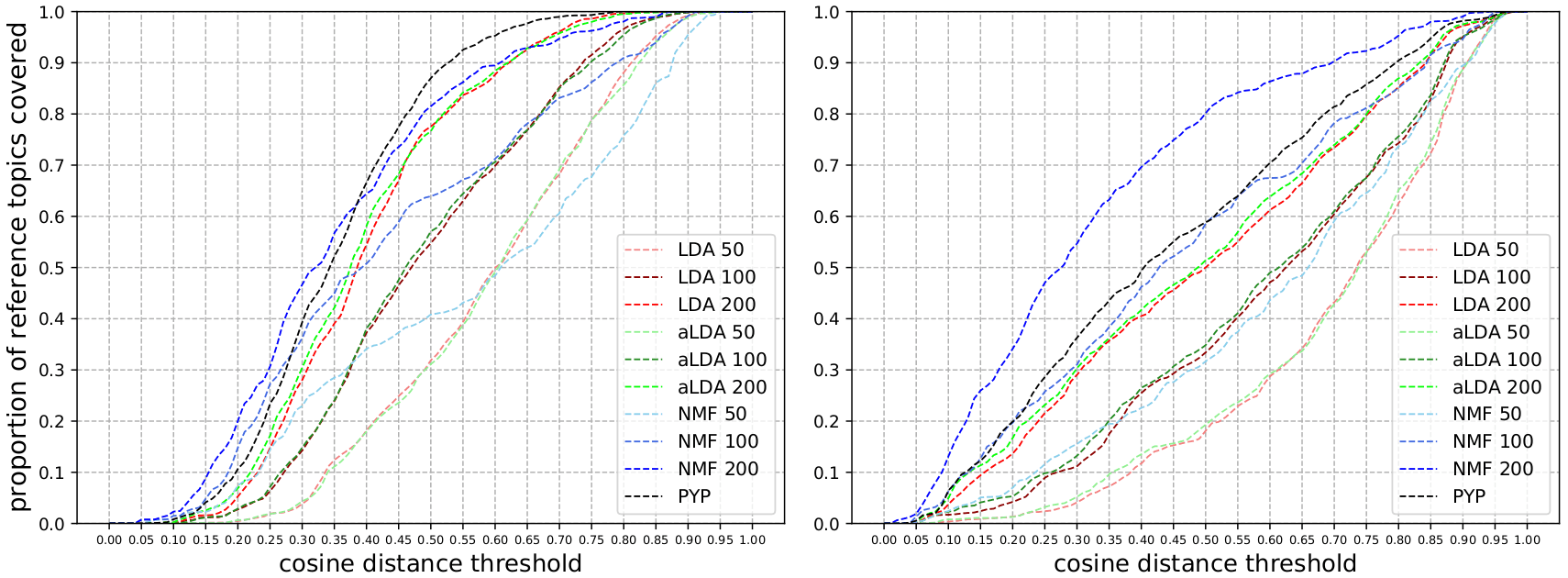
A prevalent use case of topic models is that of topic discovery. However, most of the topic model evaluation methods rely on abstract metrics such as perplexity or topic coherence. The topic coverage approach is to measure the models' performance by matching model-generated topics to a fixed set of reference topics - topics discovered by humans and represented in a machine-readable format. This way, the models are evaluated in the context of their use, by essentially simulating topic modeling in a fixed setting defined by a text collection and a set of reference topics. Reference topics represent a ground truth that can be used to evaluate both topic models and other measures of model performance. This coverage approach enables large-scale automatic evaluation of existing and future topic models.
(Image credit: Papersgraph)

Benchmarks
These leaderboards are used to track progress in topic-coverage
Trend
Dataset
Best Model
Actions

Topic modeling topic coverage dataset - news
Topic modeling topic coverage dataset - news

Topic modeling topic coverage dataset - bio
Topic modeling topic coverage dataset - bio
Libraries
iUse these libraries to find topic-coverage models and implementations
Datasets
Subtasks
No subtasks available.
Most implemented papers
A Topic Coverage Approach to Evaluation of Topic Models
Damir Korenčić, S. Ristov, J. Repar, J. Šnajder•Thu Dec 10 2020
An approach to topic model evaluation based on measuring topic coverage is investigated, and measures of coverage based on matching between model topics and reference topics are proposed.
24
