3260 papers • 126 benchmarks • 313 datasets
This task has no description! Would you like to contribute one?
(Image credit: Papersgraph)

These leaderboards are used to track progress in cross-document-coreference-resolution
No benchmarks available.
Use these libraries to find cross-document-coreference-resolution models and implementations
No subtasks available.
This work proposes a pragmatic evaluation methodology which assumes access to only raw text -- rather than assuming gold mentions, disregards singleton prediction, and addresses typical targeted settings in CD coreference resolution.
SciCo, an expert-annotated dataset for H-CDCR in scientific papers, is created, 3X larger than the prominent ECB+ resource, and is studied to study strong baseline models that are customize for H -CDCR, and highlight challenges for future work.
CoRefi is a web-based coreference annotation suite, oriented for crowdsourcing, that provides guided onboarding for the task as well as a novel algorithm for a reviewing phase.
This work jointly model entity and event coreference, and proposes a neural architecture for cross-document coreference resolution using its lexical span, surrounding context, and relation to entity (event) mentions via predicate-arguments structures.
A joint model for predicate argument alignment is presented that leverages multiple sources of semantic information, including temporal ordering constraints between events, in a max-margin framework to find a globally consistent view of entities and events across multiple documents.
This work introduces the first end-to-end model for CD coreference resolution from raw text, which extends the prominent model for within-document coreference to the CD setting and achieves competitive results for event and entity coreference Resolution on gold mentions.
A phrasing diversity metric (PD) is proposed that encounters for the diversity of full phrases unlike the previously proposed metrics and allows to evaluate lexical diversity of the CDCR datasets in a higher precision.
A novel model is presented that integrates a powerful coreference scoring scheme into the DPR architecture, yielding improved performance and adapting the prominent Deep Passage Retrieval model to the setting, as an appealing baseline.
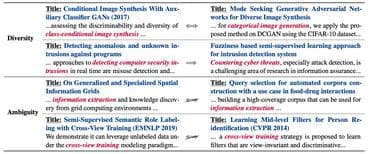
It is argued that models should not exploit the synthetic topic structure of the standard ECB+ dataset, forcing models to confront the lexical ambiguity challenge, as intended by the dataset creators.
CHAMP is an open source tool allowing to incrementally construct both clusters and hierarchy simultaneously over any type of texts, which significantly reduces annotation time compared to the common pairwise annotation approach and also guarantees maintaining transitivity at the cluster and hierarchy levels.
Adding a benchmark result helps the community track progress.