3260 papers • 126 benchmarks • 313 datasets
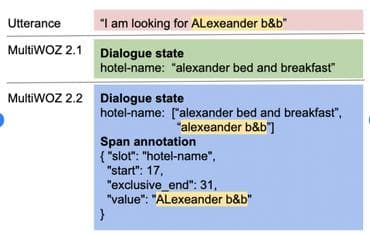
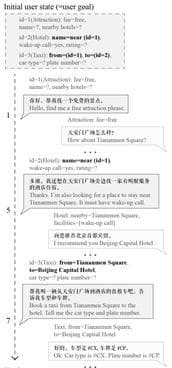
Dialogue state tacking consists of determining at each turn of a dialogue the full representation of what the user wants at that point in the dialogue, which contains a goal constraint, a set of requested slots, and the user's dialogue act.
(Image credit: Papersgraph)

These leaderboards are used to track progress in dialogue-state-tracking-14
Use these libraries to find dialogue-state-tracking-14 models and implementations
No subtasks available.
This work introduces the the Schema-Guided Dialogue (SGD) dataset, containing over 16k multi-domain conversations spanning 16 domains, and presents a schema-guided paradigm for task-oriented dialogue, in which predictions are made over a dynamic set of intents and slots provided as input.
The interaction history is utilized by editing the previous predicted query to improve the generation quality of SQL queries and the benefit of editing compared with the state-of-the-art baselines which generate SQL from scratch is evaluated.
CoSQL is presented, a corpus for building cross-domain, general-purpose database (DB) querying dialogue systems that includes SQL-grounded dialogue state tracking, response generation from query results, and user dialogue act prediction and a set of strong baselines are evaluated.
The accuracy gaps between the current and the ground truth-given situations are analyzed and it is suggested that it is a promising direction to improve state operation prediction to boost the DST performance.
This paper introduces MultiWOZ 2.3, in which it differentiate incorrect annotations in dialogue acts from dialogue states, and identifies a lack of co-reference when publishing the updated dataset, to ensure consistency between dialogue acts and dialogue states.
This work introduces Korean Language Understanding Evaluation (KLUE), a collection of 8 Korean natural language understanding (NLU) tasks, including Topic Classification, SemanticTextual Similarity, Natural Language Inference, Named Entity Recognition, Relation Extraction, Dependency Parsing, Machine Reading Comprehension, and Dialogue State Tracking, and provides suitable evaluation metrics and fine-tuning recipes for pretrained language models for each task.
The evaluation shows that the Attract-Repel method can make use of existing cross-lingual lexicons to construct high-quality vector spaces for a plethora of different languages, facilitating semantic transfer from high- to lower-resource ones.
A novel counter-fitting method is presented which injects antonymy and synonymy constraints into vector space representations in order to improve the vectors' capability for judging semantic similarity.
Adding a benchmark result helps the community track progress.