3260 papers • 126 benchmarks • 313 datasets
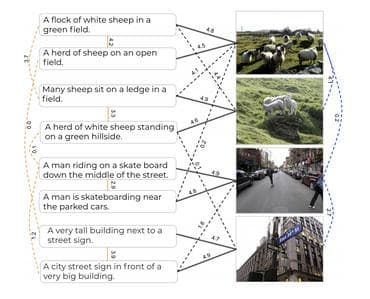
Semantic textual similarity deals with determining how similar two pieces of texts are. This can take the form of assigning a score from 1 to 5. Related tasks are paraphrase or duplicate identification. Image source: Learning Semantic Textual Similarity from Conversations
(Image credit: Papersgraph)

These leaderboards are used to track progress in semantic-textual-similarity-5
Use these libraries to find semantic-textual-similarity-5 models and implementations
A new language representation model, BERT, designed to pre-train deep bidirectional representations from unlabeled text by jointly conditioning on both left and right context in all layers, which can be fine-tuned with just one additional output layer to create state-of-the-art models for a wide range of tasks.
Sentence-BERT (SBERT), a modification of the pretrained BERT network that use siamese and triplet network structures to derive semantically meaningful sentence embeddings that can be compared using cosine-similarity is presented.
It is found that BERT was significantly undertrained, and can match or exceed the performance of every model published after it, and the best model achieves state-of-the-art results on GLUE, RACE and SQuAD.
This work presents two parameter-reduction techniques to lower memory consumption and increase the training speed of BERT, and uses a self-supervised loss that focuses on modeling inter-sentence coherence.
This systematic study compares pre-training objectives, architectures, unlabeled datasets, transfer approaches, and other factors on dozens of language understanding tasks and achieves state-of-the-art results on many benchmarks covering summarization, question answering, text classification, and more.
This work proposes a method to pre-train a smaller general-purpose language representation model, called DistilBERT, which can be fine-tuned with good performances on a wide range of tasks like its larger counterparts, and introduces a triple loss combining language modeling, distillation and cosine-distance losses.
It is found that transfer learning using sentence embeddings tends to outperform word level transfer with surprisingly good performance with minimal amounts of supervised training data for a transfer task.
XLNet is proposed, a generalized autoregressive pretraining method that enables learning bidirectional contexts by maximizing the expected likelihood over all permutations of the factorization order and overcomes the limitations of BERT thanks to its autore progressive formulation.
It is shown how universal sentence representations trained using the supervised data of the Stanford Natural Language Inference datasets can consistently outperform unsupervised methods like SkipThought vectors on a wide range of transfer tasks.
SimCSE is presented, a simple contrastive learning framework that greatly advances the state-of-the-art sentence embeddings and regularizes pre-trainedembeddings’ anisotropic space to be more uniform, and it better aligns positive pairs when supervised signals are available.
Adding a benchmark result helps the community track progress.