3260 papers • 126 benchmarks • 313 datasets
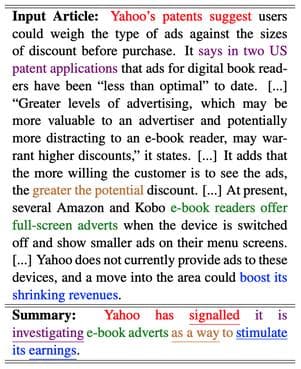
Abstractive Text Summarization is the task of generating a short and concise summary that captures the salient ideas of the source text. The generated summaries potentially contain new phrases and sentences that may not appear in the source text. Source: Generative Adversarial Network for Abstractive Text Summarization Image credit: Abstractive Text Summarization using Sequence-to-sequence RNNs and Beyond
(Image credit: Papersgraph)

These leaderboards are used to track progress in abstractive-text-summarization-2
Use these libraries to find abstractive-text-summarization-2 models and implementations
A new simple network architecture, the Transformer, based solely on attention mechanisms, dispensing with recurrence and convolutions entirely is proposed, which generalizes well to other tasks by applying it successfully to English constituency parsing both with large and limited training data.
BART is presented, a denoising autoencoder for pretraining sequence-to-sequence models, which matches the performance of RoBERTa on GLUE and SQuAD, and achieves new state-of-the-art results on a range of abstractive dialogue, question answering, and summarization tasks.
A novel architecture that augments the standard sequence-to-sequence attentional model in two orthogonal ways, using a hybrid pointer-generator network that can copy words from the source text via pointing, which aids accurate reproduction of information, while retaining the ability to produce novel words through the generator.
This paper introduces a novel document-level encoder based on BERT which is able to express the semantics of a document and obtain representations for its sentences and proposes a new fine-tuning schedule which adopts different optimizers for the encoder and the decoder as a means of alleviating the mismatch between the two.
This work proposes pre-training large Transformer-based encoder-decoder models on massive text corpora with a new self-supervised objective, PEGASUS, and demonstrates it achieves state-of-the-art performance on all 12 downstream datasets measured by ROUGE scores.
A neural network model with a novel intra-attention that attends over the input and continuously generated output separately, and a new training method that combines standard supervised word prediction and reinforcement learning (RL) that produces higher quality summaries.
A new Unified pre-trained Language Model (UniLM) that can be fine-tuned for both natural language understanding and generation tasks that compares favorably with BERT on the GLUE benchmark, and the SQuAD 2.0 and CoQA question answering tasks.
GLM improves blank filling pretraining by adding 2D positional encodings and allowing an arbitrary order to predict spans, which results in performance gains over BERT and T5 on NLU tasks, and achieves the best performance from a single pretrained model with 1.25× parameters of BERT Large.
R-Drop is introduced, which forces the output distributions of different sub models generated by dropout to be consistent with each other in model training, and yields substantial improvements when applied to fine-tune large-scale pre-trained models.
This work explores the use of data-efficient content selectors to over-determine phrases in a source document that should be part of the summary, and shows that this approach improves the ability to compress text, while still generating fluent summaries.
Adding a benchmark result helps the community track progress.