natural-language-processing-2
Hypernym Discovery
3260 papers • 126 benchmarks • 313 datasets
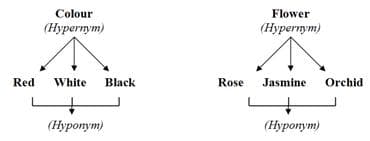
Given a corpus and a target term (hyponym), the task of hypernym discovery consists of extracting a set of its most appropriate hypernyms from the corpus. For example, for the input word “dog”, some valid hypernyms would be “canine”, “mammal” or “animal”.
(Image credit: Papersgraph)

Benchmarks
These leaderboards are used to track progress in hypernym-discovery-4
Trend
Dataset
Best Model
Actions

General
General

Medical domain
Medical domain

Music domain
Music domain
Libraries
iUse these libraries to find hypernym-discovery-4 models and implementations
Datasets
Subtasks
No subtasks available.
Most implemented papers
Hyperbolic Entailment Cones for Learning Hierarchical Embeddings
O. Ganea, Thomas Hofmann, Gary Bécigneul•Mon Apr 02 2018
This work presents a novel method to embed directed acyclic graphs through hierarchical relations as partial orders defined using a family of nested geodesically convex cones and proves that these entailment cones admit an optimal shape with a closed form expression both in the Euclidean and hyperbolic spaces.
317