3260 papers • 126 benchmarks • 313 datasets
This task has no description! Would you like to contribute one?
(Image credit: Papersgraph)

These leaderboards are used to track progress in multi-tissue-nucleus-segmentation-1
Use these libraries to find multi-tissue-nucleus-segmentation-1 models and implementations
No subtasks available.
It is shown that such a network can be trained end-to-end from very few images and outperforms the prior best method (a sliding-window convolutional network) on the ISBI challenge for segmentation of neuronal structures in electron microscopic stacks.
This work presents a conceptually simple, flexible, and general framework for object instance segmentation, which extends Faster R-CNN by adding a branch for predicting an object mask in parallel with the existing branch for bounding box recognition.
The key insight is to build “fully convolutional” networks that take input of arbitrary size and produce correspondingly-sized output with efficient inference and learning.
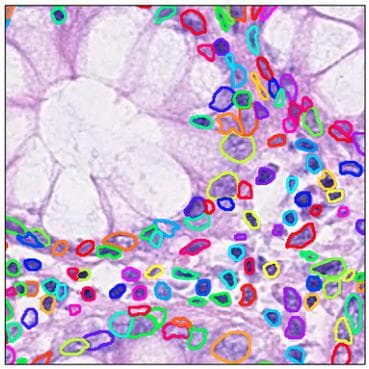
A novel convolutional neural network is presented for simultaneous nuclear segmentation and classification that leverages the instance-rich information encoded within the vertical and horizontal distances of nuclear pixels to their centres of mass to separate clustered nuclei, resulting in an accurate segmentation.
The Rotation Equivariant Vector Field Networks (RotEqNet), a Convolutional Neural Network architecture encoding rotation equivariance, invariance and covariance, is proposed and a modified convolution operator relying on this representation to obtain deep architectures is developed.
Dense Steerable Filter CNNs (DSF-CNNs) that use group convolutions with multiple rotated copies of each filter in a densely connected framework are proposed that achieve state-of-the-art performance, with significantly fewer parameters, when applied to three different tasks in the area of computational pathology.
Group equivariant Convolutional Neural Networks (G-CNNs), a natural generalization of convolutional neural networks that reduces sample complexity by exploiting symmetries and achieves state of the art results on CI- FAR10 and rotated MNIST.
A framework to encode the geometric structure of the special Euclidean motion group SE(2) in convolutional networks to yield translation and rotation equivariance via the introduction of SE( 2)-group convolution layers is proposed.
A reliable and robust method capable of dealing with data from the ‘the clinical wild’ by decoupling two simultaneous challenging tasks and taking advantage of JPFM, which can benefit from class-aware detection and class-agnostic segmentation, thus leading to a significant performance boost.
Automated nuclei segmentation and classification are the keys to analyze and understand the cellular characteristics and functionality, supporting computer-aided digital pathology in disease diagnosis. However, the task still remains challenging due to the intrinsic variations in size, intensity, and morphology of different types of nuclei. Herein, we propose a self-guided ordinal regression neural network for simultaneous nuclear segmentation and classification that can exploit the intrinsic characteristics of nuclei and focus on highly uncertain areas during training. The proposed network formulates nuclei segmentation as an ordinal regression learning by introducing a distance decreasing discretization strategy, which stratifies nuclei in a way that inner regions forming a regular shape of nuclei are separated from outer regions forming an irregular shape. It also adopts a self-guided training strategy to adaptively adjust the weights associated with nuclear pixels, depending on the difficulty of the pixels that is assessed by the network itself. To evaluate the performance of the proposed network, we employ large-scale multi-tissue datasets with 276349 exhaustively annotated nuclei. We show that the proposed network achieves the state-of-the-art performance in both nuclei segmentation and classification in comparison to several methods that are recently developed for segmentation and/or classification.
Adding a benchmark result helps the community track progress.