3260 papers • 126 benchmarks • 313 datasets
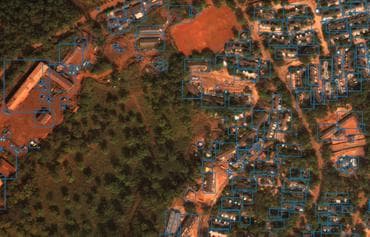
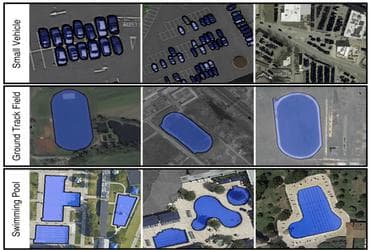
Object Detection in Aerial Images is the task of detecting objects from aerial images. ( Image credit: DOTA: A Large-Scale Dataset for Object Detection in Aerial Images )
(Image credit: Papersgraph)

These leaderboards are used to track progress in object-detection-in-aerial-images
Use these libraries to find object-detection-in-aerial-images models and implementations
No subtasks available.
A large-scale Dataset for Object deTection in Aerial images (DOTA) is introduced and state-of-the-art object detection algorithms on DOTA are evaluated, demonstrating that DOTA well represents real Earth Vision applications and are quite challenging.
Instance-level denoising on the feature map is performed to enhance the detection to small and cluttered objects and a novel IoU constant factor is added to the smooth L1 loss to address the long standing boundary problem.
An efficient real-time object detector is designed that exceeds the YOLO series and is easily extensible for many object recognition tasks such as instance segmentation and rotated object detection and introduces soft labels when calculating matching costs in the dynamic label assignment to improve accuracy.
A Circular Smooth Label technique is devised to handle the periodicity of angle and increase the error tolerance to adjacent angles and an object heading detection module is developed, which can be useful when the exact heading orientation information is needed e.g. for ship and plane heading detection.
This work proposes an effective and simple oriented object detection framework, termed Oriented R-CNN, which is a general two-stage oriented detector with promising accuracy and efficiency, and an oriented Region Proposal Network (oriented RPN) that directly generates high-quality oriented proposals in a nearly cost-free manner.
Object detection has been a building block in computer vision. Though considerable progress has been made, there still exist challenges for objects with small size, arbitrary direction, and dense distribution. Apart from natural images, such issues are especially pronounced for aerial images of great importance. This paper presents a novel multi-category rotation detector for small, cluttered and rotated objects, namely SCRDet. Specifically, a sampling fusion network is devised which fuses multi-layer feature with effective anchor sampling, to improve the sensitivity to small objects. Meanwhile, the supervised pixel attention network and the channel attention network are jointly explored for small and cluttered object detection by suppressing the noise and highlighting the objects feature. For more accurate rotation estimation, the IoU constant factor is added to the smooth L1 loss to address the boundary problem for the rotating bounding box. Extensive experiments on two remote sensing public datasets DOTA, NWPU VHR-10 as well as natural image datasets COCO, VOC2007 and scene text data ICDAR2015 show the state-of-the-art performance of our detector. The code and models will be available at https://github.com/DetectionTeamUCAS.
A Rotation-equivariant Detector (ReDet) is proposed, which explicitly encodes rotation equivariance and rotation invariance and incorporates rotation- equivariant networks into the detector to extract rotation-Equivariant features, which can accurately predict the orientation and lead to a huge reduction of model size.
A single-shot alignment network (S2A-Net) consisting of two modules: a feature alignment module (FAM) and an oriented detection module (ODM) that can achieve the state-of-the-art performance on two commonly used aerial objects’ data sets while keeping high efficiency.
This paper explores a relatively less-studied methodology based on classification for rotation detection, and proposes new techniques to inherently dismiss the boundary discontinuity issue as encountered by the regression-based detectors.
This paper proposes an end-to-end refined single-stage rotation detector for fast and accurate object detection by using a progressive regression approach from coarse to fine granularity and designs a feature refinement module to improve detection performance by getting more accurate features.
Adding a benchmark result helps the community track progress.