3260 papers • 126 benchmarks • 313 datasets
Detection of the persons or the characters defined in the dataset.
(Image credit: Papersgraph)

These leaderboards are used to track progress in body-detection
Use these libraries to find body-detection models and implementations
No subtasks available.
A new framework to boost up the detection performance of the multi-level objects with region-based object detection structure with two carefully designed detectors to separately pay attention to the human body and body parts in a coarse-to-fine manner, which is called Detector-in-Detector network (DID-Net).
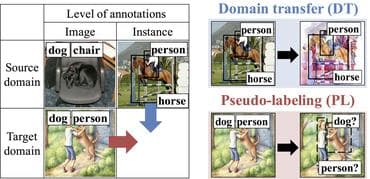
This work shows how self-supervised learning, based on a teacher-student network with a modified student network update design, can be used to build face and body detectors and demonstrates that style transfer can be incorporated into the learning pipeline to bootstrap detectors using a vast amount of out-of-domain labeled images from natural images.
A end-to-end deep learning approach to extract precise shape trajectories of generally motile and overlapping slender bodies applied to dense experiments of swimming nematodes is developed.
This work proposes a single-stage end-to-end trainable framework for tackling the HBOE problem with multi-persons by integrating the prediction of bounding boxes and direction angles in one embedding into the multi-scale anchor channel predictions of persons for concurrently benefiting from engaged intermediate features.
A deep neural network is developed that maps the phase and amplitude of WiFi signals to UV coordinates within 24 human regions and can estimate the dense pose of multiple subjects, with comparable performance to image-based approaches, by utilizing WiFi signals as the only input.
This research tries to produce machine learning algorithms that can perform cloud segmentation using only a few spectral bands, including RGB and RGBN-IR combinations, including RGB and RGBN-IR combinations.
Adding a benchmark result helps the community track progress.