3260 papers • 126 benchmarks • 313 datasets
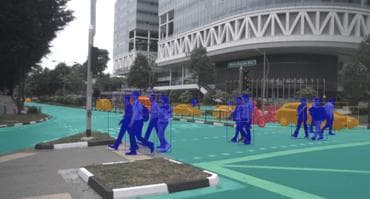
3D Object Detection is a task in computer vision where the goal is to identify and locate objects in a 3D environment based on their shape, location, and orientation. It involves detecting the presence of objects and determining their location in the 3D space in real-time. This task is crucial for applications such as autonomous vehicles, robotics, and augmented reality. ( Image credit: AVOD )
(Image credit: Papersgraph)

These leaderboards are used to track progress in 3d-object-detection
Use these libraries to find 3d-object-detection models and implementations
YOLO9000, a state-of-the-art, real-time object detection system that can detect over 9000 object categories, is introduced and a method to jointly train on object detection and classification is proposed, both novel and drawn from prior work.
This work directly operates on raw point clouds by popping up RGBD scans and leverages both mature 2D object detectors and advanced 3D deep learning for object localization, achieving efficiency as well as high recall for even small objects.
benchmarks suggest that PointPillars is an appropriate encoding for object detection in point clouds, and proposes a lean downstream network.
Robust detection and tracking of objects is crucial for the deployment of autonomous vehicle technology. Image based benchmark datasets have driven development in computer vision tasks such as object detection, tracking and segmentation of agents in the environment. Most autonomous vehicles, however, carry a combination of cameras and range sensors such as lidar and radar. As machine learning based methods for detection and tracking become more prevalent, there is a need to train and evaluate such methods on datasets containing range sensor data along with images. In this work we present nuTonomy scenes (nuScenes), the first dataset to carry the full autonomous vehicle sensor suite: 6 cameras, 5 radars and 1 lidar, all with full 360 degree field of view. nuScenes comprises 1000 scenes, each 20s long and fully annotated with 3D bounding boxes for 23 classes and 8 attributes. It has 7x as many annotations and 100x as many images as the pioneering KITTI dataset. We define novel 3D detection and tracking metrics. We also provide careful dataset analysis as well as baselines for lidar and image based detection and tracking. Data, development kit and more information are available online.
Extensive experiments on the 3D detection benchmark of KITTI dataset show that the proposed architecture outperforms state-of-the-art methods with remarkable margins by using only point cloud as input.
The proposed PV-RCNN surpasses state-of-the-art 3D detection methods with remarkable margins and deeply integrates both 3D voxel Convolutional Neural Network and PointNet-based set abstraction to learn more discriminative point cloud features.
The framework, CenterPoint, first detects centers of objects using a keypoint detector and regresses to other attributes, including 3D size, 3D orientation, and velocity, and refines these estimates using additional point features on the object.
This work proposes VoteNet, an end-to-end 3D object detection network based on a synergy of deep point set networks and Hough voting that achieves state-of-the-art 3D detection on two large datasets of real 3D scans, ScanNet and SUN RGB-D with a simple design, compact model size and high efficiency.
The center point based approach, CenterNet, is end-to-end differentiable, simpler, faster, and more accurate than corresponding bounding box based detectors and performs competitively with sophisticated multi-stage methods and runs in real-time.
VoxelNet is proposed, a generic 3D detection network that unifies feature extraction and bounding box prediction into a single stage, end-to-end trainable deep network and learns an effective discriminative representation of objects with various geometries, leading to encouraging results in3D detection of pedestrians and cyclists.
Adding a benchmark result helps the community track progress.