3260 papers • 126 benchmarks • 313 datasets
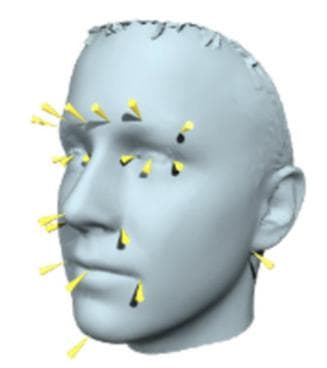
Facial landmark detection in the unsupervised setting popularized by [1]. The evaluation occurs in two stages: (1) Embeddings are first learned in an unsupervised manner (i.e. without labels); (2) A simple regressor is trained to regress landmarks from the unsupervised embedding. [1] Thewlis, James, Hakan Bilen, and Andrea Vedaldi. "Unsupervised learning of object landmarks by factorized spatial embeddings." Proceedings of the IEEE International Conference on Computer Vision. 2017. ( Image credit: Unsupervised learning of object landmarks by factorized spatial embeddings )
(Image credit: Papersgraph)

These leaderboards are used to track progress in unsupervised-facial-landmark-detection-1
Use these libraries to find unsupervised-facial-landmark-detection-1 models and implementations
No subtasks available.
A more powerful form of unsupervised disentangling becomes possible in template coordinates, allowing us to successfully decompose face images into shading and albedo, and further manipulate face images.
This work proposes a method for learning landmark detectors for visual objects (such as the eyes and the nose in a face) without any manual supervision and introduces a tight bottleneck in the geometry-extraction process that selects and distils geometry-related features.
A network is introduced that is trained to embed multiple frames from the same video face-track into a common low-dimensional space and learns a meaningful face embedding that encodes information about head pose, facial landmarks and facial expression, without having been supervised with any labelled data.
This work presents an unsupervised approach for disentangling appearance and shape by learning parts consistently over all instances of a category by simultaneously exploiting invariance and equivariance constraints between synthetically transformed images.
This paper proposes a novel unsupervised approach that can discover and learn landmarks in object categories, thus characterizing their structure, and shows that the learned landmarks establish meaningful correspondences between different object instances in a category without having to impose this requirement explicitly.
This work proposes a self-supervised deep learning approach for part segmentation, where several loss functions are devised that aids in predicting part segments that are geometrically concentrated, robust to object variations and are also semantically consistent across different object instances.
This paper proposes an autoencoding formulation to discover landmarks as explicit structural representations, which naturally creates an unsupervised, perceptible interface to manipulate object shapes and decode images with controllable structures.
A new perspective on the equivariance approach is developed by noting that dense landmark detectors can be interpreted as local image descriptors equipped with invariance to intra-category variations, and proposing a direct method to enforce such an invariance in the standard equivariant loss.
LatentKeypointGAN is introduced, a two-stage GAN that is trained endto-end on the classical GAN objective yet internally conditioned on a set of sparse keypoints with associated appearance embeddings that respectively control the position and style of the generated objects and their parts.
Deep Feature Factorization is used to gain insight into a deep convolutional neural network's learned features, where it detects hierarchical cluster structures in feature space as heat maps.
Adding a benchmark result helps the community track progress.