3260 papers • 126 benchmarks • 313 datasets
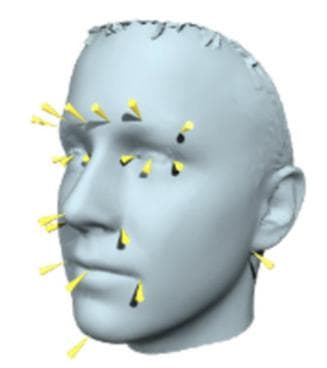
Facial Landmark Detection is a computer vision task that involves detecting and localizing specific points or landmarks on a face, such as the eyes, nose, mouth, and chin. The goal is to accurately identify these landmarks in images or videos of faces in real-time and use them for various applications, such as face recognition, facial expression analysis, and head pose estimation. ( Image credit: Style Aggregated Network for Facial Landmark Detection )
(Image credit: Papersgraph)

These leaderboards are used to track progress in facial-landmark-detection-1
Use these libraries to find facial-landmark-detection-1 models and implementations
A simple modification is introduced to augment the high-resolution representation by aggregating the (upsampled) representations from all the parallel convolutions rather than only the representation from thehigh-resolution convolution, which leads to stronger representations, evidenced by superior results.
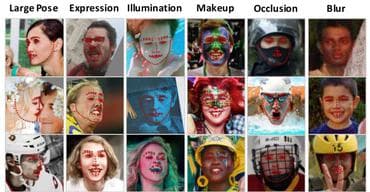
This paper investigates a neat model with promising detection accuracy under wild environments e.g., unconstrained pose, expression, lighting, and occlusion conditions) and super real-time speed on a mobile device.
The FacePoseNet (FPN) is claimed to be a far faster and far more accurate face alignment method than using facial landmark detectors, and aligns faces at a small fraction of the computational cost of comparably accurate landmark detectors.
A method that can accurately estimate the positions of relevant facial landmarks in real-time even on hardware with limited processing power, such as mobile devices is described.
A novel boundary-aware face alignment algorithm by utilising boundary lines as the geometric structure of a human face to help facial landmark localisation, which outperforms state-of-the-art methods by a large margin.
The architecture allows direct end-to-end training of a model-based landmark detection method and shows that deep neural networks can be used to reliably predict model parameters directly without the need for an iterative optimization.
This paper proposes an interaction mechanism between a teacher and two students to generate more reliable pseudo labels for unlabeled data, which are beneficial to semi-supervised facial landmark detection.
This paper proposes learning to impute the labels of unlabeled samples such that a network achieves better generalization when it is trained on these labels, and poses the problem in a learning-to-learn formulation.
COCO-WholeBody is introduced which extends COCO dataset with whole-body annotations and is the first benchmark that has manual annotations on the entire human body, including 133 dense landmarks with 68 on the face, 42 on hands and 23 on the body and feet.
The proposed Pixel-in-Pixel Net for facial landmark detection is equipped with a novel detection head based on heatmap regression, which conducts score and offset predictions simultaneously on low-resolution feature maps, enabling the inference time to be largely reduced without sacrificing model accuracy.
Adding a benchmark result helps the community track progress.