3260 papers • 126 benchmarks • 313 datasets
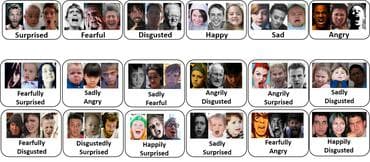
Facial Expression Recognition (FER) is a computer vision task aimed at identifying and categorizing emotional expressions depicted on a human face. The goal is to automate the process of determining emotions in real-time, by analyzing the various features of a face such as eyebrows, eyes, mouth, and other features, and mapping them to a set of emotions such as anger, fear, surprise, sadness and happiness. ( Image credit: DeXpression )
(Image credit: Papersgraph)

These leaderboards are used to track progress in facial-expression-recognition-fer
Use these libraries to find facial-expression-recognition-fer models and implementations
The datasets created for these challenges are described, the results of the competitions are summarized, and some comments are provided on what kind of knowledge can be gained from machine learning competitions.
This paper shows how to learn a deep convolutional neural network (DCNN) from noisy labels, using facial expression recognition as an example, and compares four different approaches to utilizing the multiple labels.
This work proposes a novel FER framework, named Facial Motion Prior Networks (FMPN), which introduces an addition branch to generate a facial mask so as to focus on facial muscle moving regions.
The proposed architecture is independent of any hand-crafted feature extraction and performs better than the earlier proposed convolutional neural network based approaches and visualize the automatically extracted features which have been learned by the network in order to provide a better understanding.
This survey provides a comprehensive review of deep FER, including datasets and algorithms that provide insights into these intrinsic problems, and introduces existing novel deep neural networks and related training strategies that are designed for FER based on both static images and dynamic image sequences.
A deep learning approach based on attentional convolutional network that is able to focus on important parts of the face and achieves significant improvement over previous models on multiple datasets, including FER-2013, CK+, FERG, and JAFFE is proposed.
This work proposes an effective training strategy in the presence of noisy labels, called as Consensual Collaborative Training (CCT) framework, which co-trains three networks jointly using a convex combination of supervision loss and consistency loss, without making any assumption about the noise distribution.
A comprehensive comparison of several successful deep learning-based face detectors is conducted to uncover their efficiency using two metrics: FLOPs and latency and can guide to choose appropriate face detectors for different applications and also to develop more efficient and accurate detectors.
A deep learning model to improve engagement recognition from images that overcomes the data sparsity challenge by pre-training on readily available basic facial expression data, before training on specialised engagement data is presented.
The popular knowledge distillation method is employed for creating extremely small and fast convolutional neural networks (CNN) for the problem of facial expression recognition from frontal face images and an intriguing improvement in generalization is found when max-pooling is used.
Adding a benchmark result helps the community track progress.