3260 papers • 126 benchmarks • 313 datasets
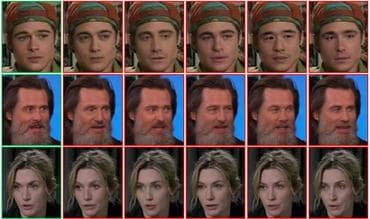
Face swapping refers to the task of swapping faces between images or in an video, while maintaining the rest of the body and environment context. ( Image credit: Swapped Face Detection using Deep Learning and Subjective Assessment )
(Image credit: Papersgraph)

These leaderboards are used to track progress in face-swapping
Use these libraries to find face-swapping models and implementations
No subtasks available.
This paper proposes an automated benchmark for facial manipulation detection, and shows that the use of additional domain-specific knowledge improves forgery detection to unprecedented accuracy, even in the presence of strong compression, and clearly outperforms human observers.
A method to automatically and efficiently detect face tampering in videos, and particularly focuses on two recent techniques used to generate hyper-realistic forged videos: Deepfake and Face2Face.
This work presents a new large-scale challenging DeepFake video dataset, Celeb-DF, which contains 5,639 high-quality DeepFake videos of celebrities generated using improved synthesis process and conducts a comprehensive evaluation of DeepFake detection methods and datasets to demonstrate the escalated level of challenges posed by Celebrity-DF.
DeepFaceLab, the current dominant deepfake framework for face-swapping, is presented and its pipeline, through which every aspect of the pipeline can be modified painlessly by users to achieve their customization purpose, is introduced.
A novel image representation called face X-ray is proposed, which only assumes the existence of a blending step and does not rely on any knowledge of the artifacts associated with a specific face manipulation technique, and can be trained without fake images generated by any of the state-of-the-art face manipulation methods.
Although Deep fake detection is extremely difficult and still an unsolved problem, a Deepfake detection model trained only on the DFDC can generalize to real "in-the-wild" Deepfake videos, and such a model can be a valuable analysis tool when analyzing potentially Deepfaked videos.
This work describes a new method to expose fake face videos generated with neural networks based on detection of eye blinking in the videos, which is a physiological signal that is not well presented in the synthesized fake videos.
This study focuses on video deep fake detection on faces, given that most methods are becoming extremely accurate in the generation of realistic human faces, and presents a straightforward inference procedure based on a simple voting scheme for handling multiple faces in the same video shot.
This work proposes a novel attributes encoder for extracting multi-level target face attributes, and a new generator with carefully designed Adaptive Attentional Denormalization layers to adaptively integrate the identity and the attributes for face synthesis.
A new deep learning based method that can effectively distinguish AI-generated fake videos from real videos is described, which saves a plenty of time and resources in training data collection and is more robust compared to others.
Adding a benchmark result helps the community track progress.