3260 papers • 126 benchmarks • 313 datasets
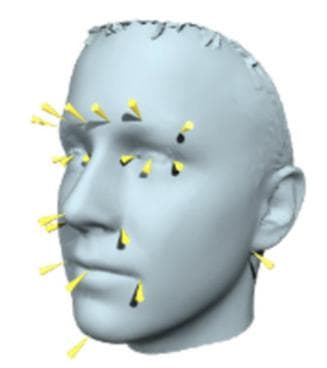
Face alignment is the task of identifying the geometric structure of faces in digital images, and attempting to obtain a canonical alignment of the face based on translation, scale, and rotation. ( Image credit: 3DDFA_V2 )
(Image credit: Papersgraph)

These leaderboards are used to track progress in face-alignment
Use these libraries to find face-alignment models and implementations
No subtasks available.
The superiority of the proposed HRNet in a wide range of applications, including human pose estimation, semantic segmentation, and object detection, is shown, suggesting that the HRNet is a stronger backbone for computer vision problems.
A simple modification is introduced to augment the high-resolution representation by aggregating the (upsampled) representations from all the parallel convolutions rather than only the representation from thehigh-resolution convolution, which leads to stronger representations, evidenced by superior results.
This paper investigates a neat model with promising detection accuracy under wild environments e.g., unconstrained pose, expression, lighting, and occlusion conditions) and super real-time speed on a mobile device.
An elegant and robust way to determine pose is presented by training a multi-loss convolutional neural network on 300W-LP, a large synthetically expanded dataset, to predict intrinsic Euler angles directly from image intensities through joint binned pose classification and regression.
Faces Learned with an Articulated Model and Expressions is low-dimensional but more expressive than the FaceWarehouse model and the Basel Face Model and is compared to these models by fitting them to static 3D scans and 4D sequences using the same optimization method.
This paper investigates how far a very deep neural network is from attaining close to saturating performance on existing 2D and 3D face alignment datasets and builds a very strong baseline for this purpose.
This paper presents an attention-guided deformable convolutional network for hand-held multi-frame high dynamic range (HDR) imaging, namely ADNet, and proposes to align the gamma-corrected images in the feature-level with a Pyramid, Cascading and Deformable alignment module.
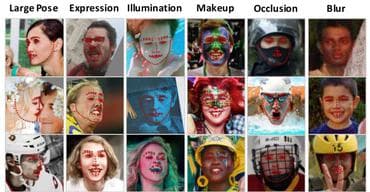
The proposed RetinaFace can not only predict accurate 3D vertices but also estimate precise pose, and is able to estimate precise pose under variations of pose, expression, illumination, background, occlusion, and image quality.
A novel loss function is proposed, named Adaptive Wing loss, that is able to adapt its shape to different types of ground truth heatmap pixels, that penalizes loss more on foreground pixels while less on background pixels.
Adding a benchmark result helps the community track progress.