3260 papers • 126 benchmarks • 313 datasets
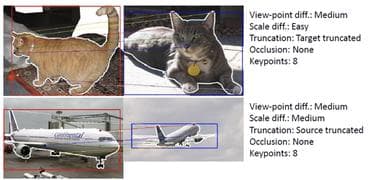
The task of semantic correspondence aims to establish reliable visual correspondence between different instances of the same object category.
(Image credit: Papersgraph)

These leaderboards are used to track progress in semantic-correspondence-9
Use these libraries to find semantic-correspondence-9 models and implementations
An end-to-end trainable convolutional neural network architecture that identifies sets of spatially consistent matches by analyzing neighbourhood consensus patterns in the 4D space of all possible correspondences between a pair of images without the need for a global geometric model is developed.
A training dataset for supervised machine learning called PatentMatch, which contains pairs of claims from patent applications and semantically corresponding text passages of different degrees from cited patent documents, is created to address the computer-assisted search for prior art.
A self-ensembling framework where instance segmentation and semantic correspondence are jointly guided by a structured teacher in addition to the bounding box supervision, which shows a symbiotic relationship where the two tasks mutually benefit from each other.
This paper presents a fast exemplar-based image colorization approach using color embeddings named Color2Embed, which adopts a self-augmented self-reference learning scheme, where the reference image is generated by graphical transformations from the original colorful one whereby the training can be formulated in a paired manner.
A convolutional neural network architecture for semantic alignment that is trainable in an end-to-end manner from weak image-level supervision in the form of matching image pairs that computes the quality of the alignment based on only geometrically consistent correspondences thereby reducing the effect of background clutter.
This work proposes an iterative Semantic Pose Alignment Network, called iSPA-Net, which focuses on exploiting semantic 3D structural regularity to solve the task of fine-grained pose estimation by predicting viewpoint difference between a given pair of images.
Semantically Proportional Mixing (SnapMix) is proposed that exploits class activation map (CAM) to lessen the label noise in augmenting fine-grained data and consistently outperforms existing mixed-based approaches regardless of different datasets or network depths.
This work introduces a novel cost aggregation network, dubbed Volumetric Aggregation with Transformers (VAT), to tackle the few-shot segmentation task by using both convolutions and transformers to efficiently handle high dimensional correlation maps between query and support.
A detector with the ability to predict both open-vocabulary objects and their part segmentation and a detector that generalizes to a wide range of part segmentation datasets while achieving better performance than dataset-specific training is proposed.
This work presents a model that uses convolutional neural networks to capture semantic correspondence between a mention's context and a proposed target entity, outperforming the prior systems of Durrett and Klein (2014) and Nguyen et al. (2014).
Adding a benchmark result helps the community track progress.