3260 papers • 126 benchmarks • 313 datasets
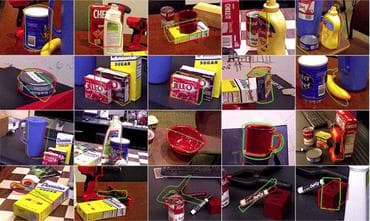
Image: Zeng et al
(Image credit: Papersgraph)

These leaderboards are used to track progress in 6d-pose-estimation-using-rgbd-7
Use these libraries to find 6d-pose-estimation-using-rgbd-7 models and implementations
No subtasks available.
This work introduces PoseCNN, a new Convolutional Neural Network for 6D object pose estimation, which is highly robust to occlusions, can handle symmetric objects, and provide accurate pose estimation using only color images as input.
DenseFusion is a generic framework for estimating 6D pose of a set of known objects from RGB-D images that processes the two data sources individually and uses a novel dense fusion network to extract pixel-wise dense feature embedding, from which the pose is estimated.
Although the top-performing methods rely on RGB-D image channels, strong results were achieved when only RGB channels were used at both training and test time, and the photorealism of PBR images was demonstrated effective despite the augmentation.
It is shown that a mild relaxation of the task and workspace constraints implicit in existing object grasping datasets can cause neural network based grasping algorithms to fail on even a simple block stacking task when executed under more realistic circumstances.
A deep Hough voting network is proposed to detect 3D keypoints of objects and then estimate the 6D pose parameters within a least-squares fitting manner, which is a natural extension of 2D-keypoint approaches that successfully work on RGB based 6DoF estimation.
This paper presents a simple one- stage approach to predict both the 3D shape and estimate the 6D pose and size jointly in a bounding-box free manner and significantly outperforms all shape completion and categorical 6D poses and size estimation baselines on multi-object ShapeNet and NOCS datasets respectively.
GPV-Pose is proposed, a novel framework for robust category-level pose estimation, harnessing geometric insights to enhance the learning of category- level pose-sensitive features, which produces superior results to state-of-the-art competitors on common public benchmarks, whilst almost achieving real-time inference speed at 20 FPS.
This paper proposes a self-supervised method to generate a large labeled dataset without tedious manual segmentation and demonstrates that the system can reliably estimate the 6D pose of objects under a variety of scenarios.
6-PACK learns to compactly represent an object by a handful of 3D keypoints, based on which the interframe motion of an object instance can be estimated through keypoint matching, and substantially outperforms existing methods on the NOCS category-level 6D pose estimation benchmark.
A fast shape-based network (FS-Net) with efficient category-level feature extraction for 6D pose estimation and a novel decoupled rotation mechanism that employs two decoders to complementarily access the rotation information.
Adding a benchmark result helps the community track progress.