3260 papers • 126 benchmarks • 313 datasets
Material recognition focuses on identifying classes, types, states, and properties of materials.
(Image credit: Papersgraph)

These leaderboards are used to track progress in material-recognition-14
No benchmarks available.
Use these libraries to find material-recognition-14 models and implementations
No subtasks available.
This work identifies a vocabulary of forty-seven texture terms and uses them to describe a large dataset of patterns collected "in the wild", and shows that they both outperform specialized texture descriptors not only on this problem, but also in established material recognition datasets.
A Deep Texture Encoding Network with a novel Encoding Layer integrated on top of convolutional layers, which ports the entire dictionary learning and encoding pipeline into a single model, providing an end-to-end learning framework.
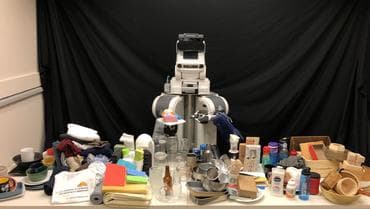
It is found that spectroscopy poses a promising approach for material classification during robotic manipulation, and how a PR2 robot can leverage spectrometers to estimate the materials of everyday objects found in the home is demonstrated.
The sparse-data problem intrinsic to novel materials development is overcome by coupling a supervised machine-learning approach with a physics-based data augmentation strategy and, using this approach, XRD spectrum acquisition and analysis occurs under 5 minutes, with accuracy comparable to human expert labeling.
It is shown that a model trained on the data outperforms a state-of-the-art model across datasets and viewpoints, and is proposed to address this with a large-scale dataset of 3.2 million dense segments on 44,560 indoor and outdoor images.
This work presents a semi-supervised learning approach for material recognition that uses generative adversarial networks (GANs) with haptic features such as force, temperature, and vibration and explores how well this approach can recognize the material of new objects.
Deep Thermal Imaging is introduced, a new approach for close-range automatic recognition of materials to enhance the understanding of people and ubiquitous technologies of their proximal environment using a low-cost mobile thermal camera integrated into a smartphone to capture thermal textures and a deep neural network classifies these textures into material types.
A multimodal sensing technique, leveraging near-infrared spectroscopy and close-range high resolution texture imaging, that enables robots to estimate the materials of household objects and a neural network architecture that learns a compact multi-modal representation of spectral measurements and texture images is presented.
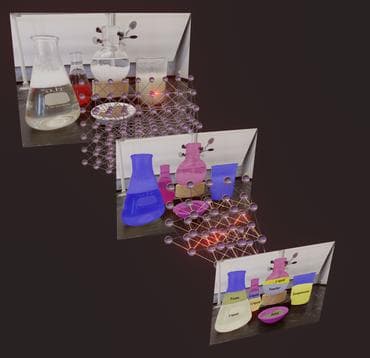
This work presents the Vector-LabPics data set, which consists of 2187 images of materials within mostly transparent vessels in a chemistry lab and other general settings, and trained neural networks achieved good accuracy in detecting and segmenting vessels and material phases, and in classifying liquids and solids.
Adding a benchmark result helps the community track progress.