3260 papers • 126 benchmarks • 313 datasets
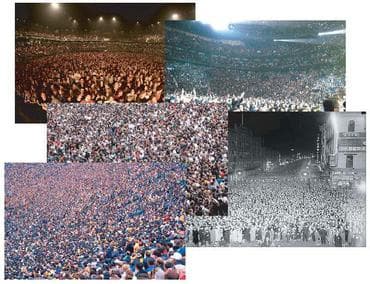
Crowd Counting is a task to count people in image. It is mainly used in real-life for automated public monitoring such as surveillance and traffic control. Different from object detection, Crowd Counting aims at recognizing arbitrarily sized targets in various situations including sparse and cluttering scenes at the same time. Source: Deep Density-aware Count Regressor
(Image credit: Papersgraph)

These leaderboards are used to track progress in crowd-counting-7
Use these libraries to find crowd-counting-7 models and implementations
No subtasks available.
The Dense Convolutional Network (DenseNet), which connects each layer to every other layer in a feed-forward fashion, and has several compelling advantages: they alleviate the vanishing-gradient problem, strengthen feature propagation, encourage feature reuse, and substantially reduce the number of parameters.
Quantitative assessments show that SegNet provides good performance with competitive inference time and most efficient inference memory-wise as compared to other architectures, including FCN and DeconvNet.
A network for Congested Scene Recognition called CSRNet is proposed to provide a data-driven and deep learning method that can understand highly congested scenes and perform accurate count estimation as well as present high-quality density maps.
S-DCNet achieves the state-of-the-art performance on three crowd counting datasets, a vehicle counting dataset (TRANCOS) and a plant counting datasets (MTC), and can generalize to open-set counts via S-DC.
A large-scale congested crowd counting and localization dataset, NWPU-Crowd is constructed, consisting of 5,109 images, in a total of 2,133,375 annotated heads with points and boxes, and a benchmark website is developed for impartially evaluating the different methods.
This paper introduces an end-to-end trainable deep architecture that combines features obtained using multiple receptive field sizes and learns the importance of each such feature at each image location, which yields an algorithm that outperforms state-of-the-art crowd counting methods, especially when perspective effects are strong.
This technical report attempts to provide efficient and solid kits addressed on the field of crowd counting, which is denoted as Crowd Counting Code Framework (C$^3$F), which has achieved the state-of-the-arts performance.
This work proposes Bayesian loss, a novel loss function which constructs a density contribution probability model from the point annotations, and outperforms previous best approaches by a large margin on the latest and largest UCF-QNRF dataset.
Over 220 works are surveyed to comprehensively and systematically study the crowd counting models, mainly CNN-based density map estimation methods to make reasonable inference and prediction for the future development of crowd counting and to provide feasible solutions for the problem of object counting in other fields.
Adding a benchmark result helps the community track progress.