3260 papers • 126 benchmarks • 313 datasets
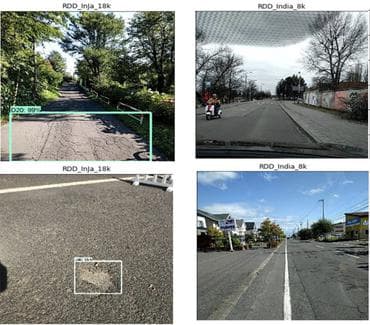
Road damage detection is the task of detecting damage in roads. ( Image credit: Road Damage Detection And Classification In Smartphone Captured Images Using Mask R-CNN )
(Image credit: Papersgraph)

These leaderboards are used to track progress in road-damage-detection-6
Use these libraries to find road-damage-detection-6 models and implementations
No subtasks available.
An assessment of the usability of the Japanese model for other countries is assessed and a large-scale heterogeneous road damage dataset comprising 26620 images collected from multiple countries using smartphones is proposed.
A deep learning-based surveying scheme to analyze the image-based distress data in real-time and propose efficient and scalable models that are tuned for pavement crack detection is introduced.
Mask-RCNN, one of the state-of-the-art algorithms for object detection, localization and instance segmentation of natural images, can be used to perform this task in a fast manner with effective results.
Automatic detection and classification of pavement distresses is critical in timely maintaining and rehabilitating pavement surfaces. With the evolution of deep learning and high performance computing, the feasibility of vision-based pavement defect assessments has significantly improved. In this study, the authors deploy state-of-the-art deep learning algorithms based on different network backbones to detect and characterize pavement distresses. The influence of different backbone models such as CSPDarknet53, Hourglass-104 and EfficientNet were studied to evaluate their classification performance. The models were trained using 21,041 images captured across urban and rural streets of Japan, Czech Republic and India. Finally, the models were assessed based on their ability to predict and classify distresses, and tested using F1 score obtained from the statistical precision and recall values. The best performing model achieved an F1 score of 0.58 and 0.57 on two test datasets released by the IEEE Global Road Damage Detection Challenge. The source code including the trained models are made available at [1].
A novel road damage detection algorithm based on unsupervised disparity map segmentation that requires no parameters when detecting road damage and performs both accurately and efficiently.
A solution to the IEEE 2020 global Road Damage Detection (RDD) Challenge is detailed, and the efforts in deploying the model on a local road network are presented, explaining the proposed methodology and encountered challenges.
The results show that the X101-FPN base model for Faster R-CNN with Detectron2’s default configurations is efficient and general enough to be transferable to different countries in this challenge.
An ensemble model for efficient detection and classification of road damages, which has been submitted to the IEEE BigData Cup Challenge 2020 and utilizes a state-of-the-art object detector known as You Only Look Once (YOLO-v4), which is trained on images of various types of road damaged.
The effect of training on a per country basis with respect to a single generalizable model is studied and shows the generalizability of the Resnet-50 model when compared to its more complex counterparts.
Adding a benchmark result helps the community track progress.