3260 papers • 126 benchmarks • 313 datasets
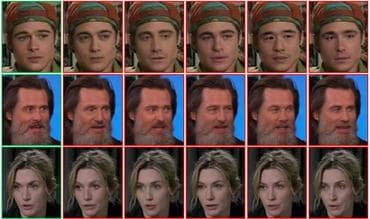
DeepFake Detection is the task of detecting fake videos or images that have been generated using deep learning techniques. Deepfakes are created by using machine learning algorithms to manipulate or replace parts of an original video or image, such as the face of a person. The goal of deepfake detection is to identify such manipulations and distinguish them from real videos or images. Description source: DeepFakes: a New Threat to Face Recognition? Assessment and Detection Image source: DeepFakes: a New Threat to Face Recognition? Assessment and Detection
(Image credit: Papersgraph)

These leaderboards are used to track progress in deepfake-detection-15
Use these libraries to find deepfake-detection-15 models and implementations
This paper proposes an automated benchmark for facial manipulation detection, and shows that the use of additional domain-specific knowledge improves forgery detection to unprecedented accuracy, even in the presence of strong compression, and clearly outperforms human observers.
It is demonstrated how combining the effectiveness of the inductive bias of CNNs with the expressivity of transformers enables them to model and thereby synthesize high-resolution images.
A method to automatically and efficiently detect face tampering in videos, and particularly focuses on two recent techniques used to generate hyper-realistic forged videos: Deepfake and Face2Face.
This work presents a new large-scale challenging DeepFake video dataset, Celeb-DF, which contains 5,639 high-quality DeepFake videos of celebrities generated using improved synthesis process and conducts a comprehensive evaluation of DeepFake detection methods and datasets to demonstrate the escalated level of challenges posed by Celebrity-DF.
This work presents a simple way to detect fake face images - so-called DeepFakes, based on a classical frequency domain analysis followed by basic classifier, which shows very good results using only a few annotated training samples and even achieved good accuracies in fully unsupervised scenarios.
A novel image representation called face X-ray is proposed, which only assumes the existence of a blending step and does not rely on any knowledge of the artifacts associated with a specific face manipulation technique, and can be trained without fake images generated by any of the state-of-the-art face manipulation methods.
This study focuses on video deep fake detection on faces, given that most methods are becoming extremely accurate in the generation of realistic human faces, and presents a straightforward inference procedure based on a simple voting scheme for handling multiple faces in the same video shot.
This work investigates factors causing biased detection in public Deepfake datasets by creating large-scale demographic and non-demographic attribute annotations with 47 different attributes for five popular Deepfake datasets and comprehensively analysing attributes resulting in AI-bias of three state-of-the-art Deepfake detection backbone models on these datasets.
This survey provides a thorough review of techniques for manipulating face images including DeepFake methods, and methods to detect such manipulations, with special attention to the latest generation of DeepFakes.
Adding a benchmark result helps the community track progress.