3260 papers • 126 benchmarks • 313 datasets
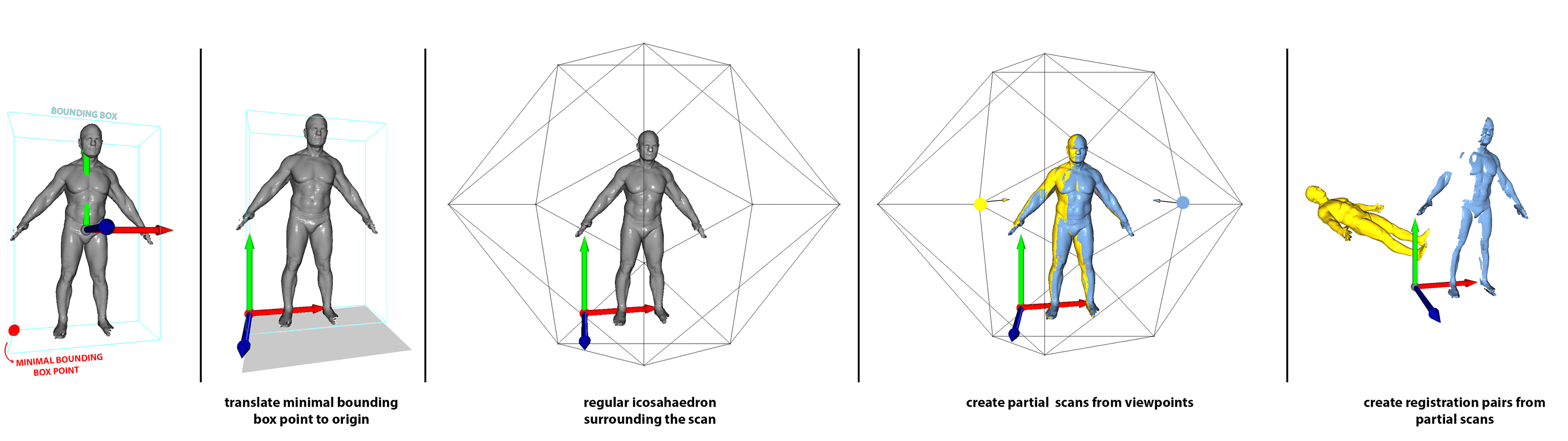
Point Cloud Registration is a fundamental problem in 3D computer vision and photogrammetry. Given several sets of points in different coordinate systems, the aim of registration is to find the transformation that best aligns all of them into a common coordinate system. Point Cloud Registration plays a significant role in many vision applications such as 3D model reconstruction, cultural heritage management, landslide monitoring and solar energy analysis. Source: Iterative Global Similarity Points : A robust coarse-to-fine integration solution for pairwise 3D point cloud registration
(Image credit: Papersgraph)

These leaderboards are used to track progress in point-cloud-registration-11
Use these libraries to find point-cloud-registration-11 models and implementations
Open3D is an open-source library that supports rapid development of software that deals with 3D data and is used in a number of published research projects and is actively deployed in the cloud.
This work proposes the first fast and certifiable algorithm for the registration of two sets of three-dimensional (3-D) points in the presence of large amounts of outlier correspondences using a truncated least squares cost and develops a second algorithm, named TEASER++, that uses graduated nonconvexity to solve the rotation subproblem and leverages Douglas-Rachford Splitting to efficiently certify global optimality.
SpineNet is proposed, a backbone with scale-permuted intermediate features and cross-scale connections that is learned on an object detection task by Neural Architecture Search, and can transfer to classification tasks, achieving 5% top-1 accuracy improvement on a challenging iNaturalist fine-grained dataset.
It is argued that PointNet itself can be thought of as a learnable "imaging" function, and classical vision algorithms for image alignment can be brought to bear on the problem -- namely the Lucas & Kanade (LK) algorithm.
The proposed RPM-Net is a less sensitive to initialization and more robust deep learning-based approach for rigid point cloud registration that uses the differentiable Sinkhorn layer and annealing to get soft assignments of point correspondences from hybrid features learned from both spatial coordinates and local geometry.
A novel framework that uses the PointNet representation to align point clouds and perform registration for applications such as tracking, 3D reconstruction and pose estimation is presented.
The ability to focus on points that are relevant for matching greatly improves performance: PREDATOR raises the rate of successful registrations by more than 20% in the low-overlap scenario, and also sets a new state of the art for the 3DMatch benchmark with 89% registration recall.
This work proposes a learning-based method, titled Deep Closest Point (DCP), inspired by recent techniques in computer vision and natural language processing, that provides a state-of-the-art registration technique and evaluates the suitability of the learned features transferred to unseen objects.
This work uses deep networks to tackle non-convexity of the alignment and partial correspondence problem in partial-to-partial point cloud registration, and shows PRNet predicts keypoints and correspondences consistently across views and objects.
This paper studies a novel setting of model-free single-object tracking (SOT), which takes the object state in the first frame as input, and jointly solves state estimation and tracking in subsequent frames, and proposes an optimization-based algorithm called SOTracker involving point cloud registration, vehicle shapes, correspondence, and motion priors.
Adding a benchmark result helps the community track progress.