3260 papers • 126 benchmarks • 313 datasets
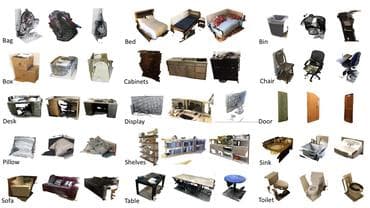
Image: Qi et al
(Image credit: Papersgraph)

These leaderboards are used to track progress in 3d-point-cloud-classification-5
Use these libraries to find 3d-point-cloud-classification-5 models and implementations
A hierarchical neural network that applies PointNet recursively on a nested partitioning of the input point set and proposes novel set learning layers to adaptively combine features from multiple scales to learn deep point set features efficiently and robustly.
This work proposes SortNet, as part of the Point Transformer, which induces input permutation invariance by selecting points based on a learned score, to extract local and global features and relate both representations by introducing the local-global attention mechanism.
This work proposes a new neural network module suitable for CNN-based high-level tasks on point clouds, including classification and segmentation called EdgeConv, which acts on graphs dynamically computed in each layer of the network.
This paper introduces the Perceiver - a model that builds upon Transformers and hence makes few architectural assumptions about the relationship between its inputs, but that also scales to hundreds of thousands of inputs, like ConvNets.
A novel framework based on Transformer, which achieves huge success in natural language processing and displays great potential in image processing, is presented, which is inherently permutation invariant for processing a sequence of points, making it well-suited for point cloud learning.
The dynamic filter is extended to a new convolution operation, named PointConv, which can be applied on point clouds to build deep convolutional networks and is able to achieve state-of-the-art on challenging semantic segmentation benchmarks on 3D point clouds.
KPConv is a new design of point convolution, i.e. that operates on point clouds without any intermediate representation, that outperform state-of-the-art classification and segmentation approaches on several datasets.
This paper presents ModelNet40-C, the first comprehensive benchmark on 3D point cloud corruption robustness, consisting of 15 common and realistic corruptions, and unveils that Transformer-based architectures with proper training recipes achieve the strongest robustness.
RS-CNN, namely, Relation-Shape Convolutional Neural Network, which extends regular grid CNN to irregular configuration for point cloud analysis, achieves the state of the arts and a hierarchical architecture can be developed to achieve contextual shape-aware learning for Point cloud analysis.
Adding a benchmark result helps the community track progress.