3260 papers • 126 benchmarks • 313 datasets
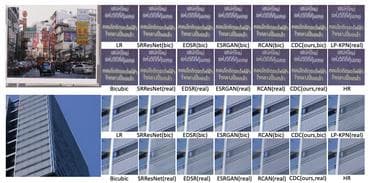
Super-Resolution is a task in computer vision that involves increasing the resolution of an image or video by generating missing high-frequency details from low-resolution input. The goal is to produce an output image with a higher resolution than the input image, while preserving the original content and structure. ( Credit: MemNet )
(Image credit: Papersgraph)

These leaderboards are used to track progress in super-resolution-10
No benchmarks available.
Use these libraries to find super-resolution-10 models and implementations
A comprehensive guide to GANs, covering their architecture, loss functions, training methods, applications, evaluation metrics, challenges, and future directions is provided.
SRGAN, a generative adversarial network (GAN) for image super-resolution (SR), is presented, to its knowledge, the first framework capable of inferring photo-realistic natural images for 4x upscaling factors and a perceptual loss function which consists of an adversarial loss and a content loss.
This work considers image transformation problems, and proposes the use of perceptual loss functions for training feed-forward networks for image transformation tasks, and shows results on image style transfer, where aFeed-forward network is trained to solve the optimization problem proposed by Gatys et al. in real-time.
This work proposes a deep learning method for single image super-resolution (SR) that directly learns an end-to-end mapping between the low/high-resolution images, represented as a deep convolutional neural network (CNN) that takes the low-resolution image as the input and outputs the high-resolution one.
This paper develops an enhanced deep super-resolution network (EDSR) with performance exceeding those of current state-of-the-art SR methods, and proposes a new multi-scale deepsuper-resolution system (MDSR) and training method, which can reconstruct high-resolution images of different upscaling factors in a single model.
This work thoroughly study three key components of SRGAN – network architecture, adversarial loss and perceptual loss, and improves each of them to derive an Enhanced SRGAN (ESRGAN), which achieves consistently better visual quality with more realistic and natural textures than SRGAN.
SinGAN, an unconditional generative model that can be learned from a single natural image, is introduced, trained to capture the internal distribution of patches within the image, and is then able to generate high quality, diverse samples that carry the same visual content as the image.
This paper presents the first convolutional neural network capable of real-time SR of 1080p videos on a single K2 GPU and introduces an efficient sub-pixel convolution layer which learns an array of upscaling filters to upscale the final LR feature maps into the HR output.
This paper investigates the construction of feed-forward denoising convolutional neural networks (DnCNNs) to embrace the progress in very deep architecture, learning algorithm, and regularization method into image Denoising, and uses residual learning and batch normalization to speed up the training process as well as boost theDenoising performance.
These latent diffusion models achieve new state of the art scores for image inpainting and class-conditional image synthesis and highly competitive performance on various tasks, including unconditional image generation, text-to-image synthesis, and super-resolution, while significantly reducing computational requirements compared to pixel-based DMs.
Adding a benchmark result helps the community track progress.