3260 papers • 126 benchmarks • 313 datasets
This task has no description! Would you like to contribute one?
(Image credit: Papersgraph)

These leaderboards are used to track progress in human-part-segmentation-11
Use these libraries to find human-part-segmentation-11 models and implementations
No subtasks available.
This work presents a conceptually simple, flexible, and general framework for object instance segmentation, which extends Faster R-CNN by adding a branch for predicting an object mask in parallel with the existing branch for bounding box recognition.
This report describes the format of the two datasets, the annotation protocols, the merging strategies, and presents the datasets statistics.
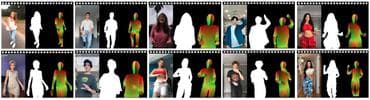
This work presents SURREAL (Synthetic hUmans foR REAL tasks): a new large-scale dataset with synthetically-generated but realistic images of people rendered from 3D sequences of human motion capture data and shows that CNNs trained on this synthetic dataset allow for accurate human depth estimation and human part segmentation in real RGB images.
This paper presents an end-to-end pipeline for solving the instance-level human analysis, named Parsing R-CNN, which processes a set of human instances simultaneously through comprehensive considering the characteristics of region-based approach and the appearance of a human, thus allowing representing the details of instances.
This work introduces a noise-tolerant method, called Self-Correction for Human Parsing (SCHP), to progressively promote the reliability of the supervised labels as well as the learned models, and is model-agnostic and can be applied to any human parsing models for further enhancing their performance.
Hulk is presented, the first multimodal human-centric generalist model, capable of addressing 2D vision, 3D vision, skeleton-based, and vision-language tasks without task-specific finetuning, and achieving state-of-the-art performance on 12 benchmarks.
Sapiens is a family of models for four fundamental human-centric vision tasks -- 2D pose estimation, body-part segmentation, depth estimation, depth estimation, and surface normal prediction that consistently surpasses existing baselines across various human-centric benchmarks.
A novel method to generate synthetic human part segmentation data using easily-obtained human keypoint annotations to exploit the anatomical similarity among human to transfer the parsing results of a person to another person with similar pose.
Adding a benchmark result helps the community track progress.