3260 papers • 126 benchmarks • 313 datasets
The goal of Video Inpainting is to fill in missing regions of a given video sequence with contents that are both spatially and temporally coherent. Video Inpainting, also known as video completion, has many real-world applications such as undesired object removal and video restoration. Source: Deep Flow-Guided Video Inpainting
(Image credit: Papersgraph)

These leaderboards are used to track progress in video-inpainting-4
Use these libraries to find video-inpainting-4 models and implementations
No subtasks available.
This paper proposes the concept of online video inpainting for autonomous vehicles to expand the field of view, thereby enhancing scene visibility, perception, and system safety and introduces the FlowLens architecture, which explicitly employs optical flow and implicitly incorporates a novel clip-recurrent transformer for feature propagation.
A deep learning based free-form video inpainting model is introduced, with proposed 3D gated convolutions to tackle the uncertainty offree-form masks and a novel Temporal PatchGAN loss to enhance temporal consistency.
This work proposes a novel deep network architecture for fast video inpainting built upon an image-based encoder-decoder model that is designed to collect and refine information from neighbor frames and synthesize still-unknown regions.
This work first synthesizes a spatially and temporally coherent optical flow field across video frames using a newly designed Deep Flow Completion network, then uses the synthesized flow fields to guide the propagation of pixels to fill up the missing regions in the video.
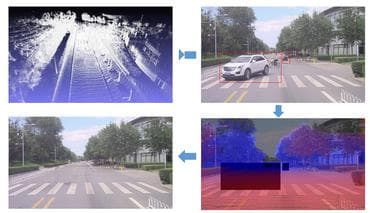
An automatic video inpainting algorithm that can remove traffic agents from videos and synthesize missing regions with the guidance of depth/point cloud is presented, and it is able to fuse multiple videos through 3D point cloud registration, making it possible to inpaint a target video with multiple source videos.
This paper simultaneously fill missing regions in all input frames by self-attention, and proposes to optimize STTN by a spatial-temporal adversarial loss to show the superiority of the proposed model.
An End-to-End framework for Flow-Guided Video Inpainting (E2 FGVI) through elaborately designed three trainable modules, namely, flow completion, feature propagation, and content hallucination modules that can be Jointly optimized, leading to a more efficient and effective inpainting process.
This work designs a lightweight flow completion network by using local aggregation and edge loss, and proposes a flow guidance feature integration module, which uses the motion discrepancy to enhance the features, together with a flow-guided feature propagation module that warps the features according to the flows.
Adding a benchmark result helps the community track progress.