3260 papers • 126 benchmarks • 313 datasets
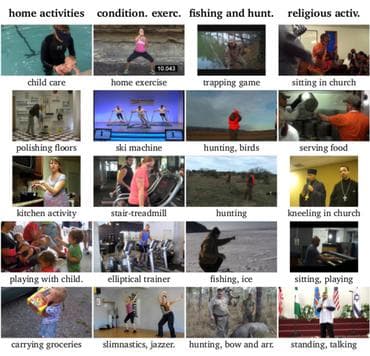
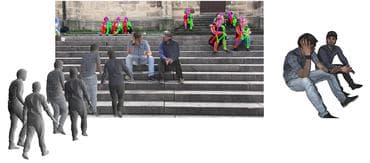
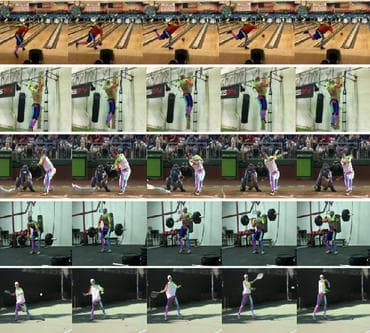
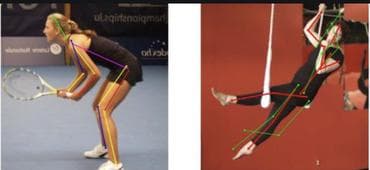
Pose Estimation is a computer vision task where the goal is to detect the position and orientation of a person or an object. Usually, this is done by predicting the location of specific keypoints like hands, head, elbows, etc. in case of Human Pose Estimation. A common benchmark for this task is MPII Human Pose ( Image credit: Real-time 2D Multi-Person Pose Estimation on CPU: Lightweight OpenPose )
(Image credit: Papersgraph)

These leaderboards are used to track progress in pose-estimation-4
Use these libraries to find pose-estimation-4 models and implementations
This work presents a conceptually simple, flexible, and general framework for object instance segmentation, which extends Faster R-CNN by adding a branch for predicting an object mask in parallel with the existing branch for bounding box recognition.
This work presents an approach to efficiently detect the 2D pose of multiple people in an image using a nonparametric representation, which it refers to as Part Affinity Fields (PAFs), to learn to associate body parts with individuals in the image.
OpenPose is released, the first open-source realtime system for multi-person 2D pose detection, including body, foot, hand, and facial keypoints, and the first combined body and foot keypoint detector, based on an internal annotated foot dataset.
This work designs a sequential architecture composed of convolutional networks that directly operate on belief maps from previous stages, producing increasingly refined estimates for part locations, without the need for explicit graphical model-style inference in structured prediction tasks such as articulated pose estimation.
This work introduces a novel convolutional network architecture for the task of human pose estimation that is described as a “stacked hourglass” network based on the successive steps of pooling and upsampling that are done to produce a final set of predictions.
The superiority of the proposed HRNet in a wide range of applications, including human pose estimation, semantic segmentation, and object detection, is shown, suggesting that the HRNet is a stronger backbone for computer vision problems.
This paper proposes a network that maintains high-resolution representations through the whole process of human pose estimation and empirically demonstrates the effectiveness of the network through the superior pose estimation results over two benchmark datasets: the COCO keypoint detection dataset and the MPII Human Pose dataset.
A simple modification is introduced to augment the high-resolution representation by aggregating the (upsampled) representations from all the parallel convolutions rather than only the representation from thehigh-resolution convolution, which leads to stronger representations, evidenced by superior results.
This paper presents non-local operations as a generic family of building blocks for capturing long-range dependencies in computer vision and improves object detection/segmentation and pose estimation on the COCO suite of tasks.
This work provides simple and effective baseline methods for pose estimation that are helpful for inspiring and evaluating new ideas for the field and achieved on challenging benchmarks.
Adding a benchmark result helps the community track progress.