3260 papers • 126 benchmarks • 313 datasets
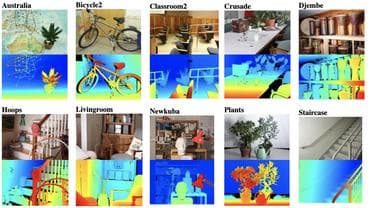
The Disparity Estimation is the task of finding the pixels in the multiscopic views that correspond to the same 3D point in the scene.
(Image credit: Papersgraph)

These leaderboards are used to track progress in disparity-estimation-2
Use these libraries to find disparity-estimation-2 models and implementations
No subtasks available.
This paper proposes three synthetic stereo video datasets with sufficient realism, variation, and size to successfully train large networks and presents a convolutional network for real-time disparity estimation that provides state-of-the-art results.
Two light models for stereo vision with reduced complexity and without sacrificing accuracy are proposed, based on a 2D and a 3D model with encoder-decoders built from2D and 3D convolutions, respectively.
This paper proposes CFNet, a Cascade and Fused cost volume based network to improve the robustness of the stereo matching network, and employs a variance-based uncertainty estimation to adaptively adjust the next stage disparity search space.
The main goal of the blur aware depth estimation (BLADE) approach is to improve disparity estimation for defocus stereo images by integrating both correspondence and defocus cues to leverage blur information where it was previously considered a drawback.
Stereo matching algorithms usually consist of four steps, including matching cost calculation, matching cost aggregation, disparity calculation, and disparity refinement. Existing CNN-based methods only adopt CNN to solve parts of the four steps, or use different networks to deal with different steps, making them difficult to obtain the overall optimal solution. In this paper, we propose a network architecture to incorporate all steps of stereo matching. The network consists of three parts. The first part calculates the multi-scale shared features. The second part performs matching cost calculation, matching cost aggregation and disparity calculation to estimate the initial disparity using shared features. The initial disparity and the shared features are used to calculate the feature constancy that measures correctness of the correspondence between two input images. The initial disparity and the feature constancy are then fed into a sub-network to refine the initial disparity. The proposed method has been evaluated on the Scene Flow and KITTI datasets. It achieves the state-of-the-art performance on the KITTI 2012 and KITTI 2015 benchmarks while maintaining a very fast running time. Source code is available at http://github.com/leonzfa/iResNet.
This paper proposes to directly add constraints to the cost volume by filtering cost volume with unimodal distribution peaked at true disparities and achieves state-of-the-art performance on Scene Flow and two KITTI stereo benchmarks.
The proposed PCW-Net is a Pyramid Combination and Warping cost volume-based network to achieve good performance on both cross-domain generalization and stereo matching accuracy on various benchmarks, and shows strong cross- domaingeneralization and outperforms existing state-of-the-arts with a large margin.
This paper proposes Stereo Mixture Density Networks (SMD-Nets), a simple yet effective learning framework compatible with a wide class of 2D and 3D architectures which ameliorates both issues of stereo matching accuracy and depth accuracy.
This work presents a real-time system producing reliable disparity estimation results on the new embedded energy-efficient GPU devices.
This work proposes a generic architecture that decomposes the label improvement task to three steps: detecting the initial label estimates that are incorrect, replacing the incorrect labels with new ones, and finally refining the renewed labels by predicting residual corrections w.r.t. them.
Adding a benchmark result helps the community track progress.