computer-vision-10
Trajectory Prediction
3260 papers • 126 benchmarks • 313 datasets
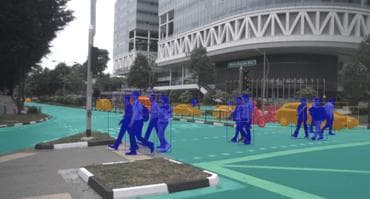
Trajectory Prediction is the problem of predicting the short-term (1-3 seconds) and long-term (3-5 seconds) spatial coordinates of various road-agents such as cars, buses, pedestrians, rickshaws, and animals, etc. These road-agents have different dynamic behaviors that may correspond to aggressive or conservative driving styles. Source: Forecasting Trajectory and Behavior of Road-Agents Using Spectral Clustering in Graph-LSTMs
(Image credit: Papersgraph)

Benchmarks
These leaderboards are used to track progress in trajectory-prediction-21
Trend
Dataset
Best Model
Actions

ETH/UCY
ETH/UCY

Stanford Drone
Stanford Drone

nuScenes
nuScenes
Libraries
iUse these libraries to find trajectory-prediction-21 models and implementations
2 papers 492
Datasets

Subtasks
Most implemented papers
Social GAN: Socially Acceptable Trajectories with Generative Adversarial Networks
Justin Johnson, S. Savarese, Li Fei-Fei, Alexandre Alahi, Agrim Gupta•Wed Mar 28 2018
A recurrent sequence-to-sequence model observes motion histories and predicts future behavior, using a novel pooling mechanism to aggregate information across people, and outperforms prior work in terms of accuracy, variety, collision avoidance, and computational complexity.
2241


![STATS SportVu NBA [ATK]](/_next/image?url=https%3A%2F%2Fweb.archive.org%2Fweb%2F20231209214226im_%2Fhttps%3A%2F%2Fproduction-media.paperswithcode.com%2Fsota-thumbs%2Ftrajectory-prediction-on-stats-sportvu-nba-small_940a96b3.png&w=128&q=75)
![STATS SportVu NBA [DEF]](/_next/image?url=https%3A%2F%2Fweb.archive.org%2Fweb%2F20231209214226im_%2Fhttps%3A%2F%2Fproduction-media.paperswithcode.com%2Fsota-thumbs%2Ftrajectory-prediction-on-stats-sportvu-nba-1-small_1e09d16d.png&w=128&q=75)


