3260 papers • 126 benchmarks • 313 datasets
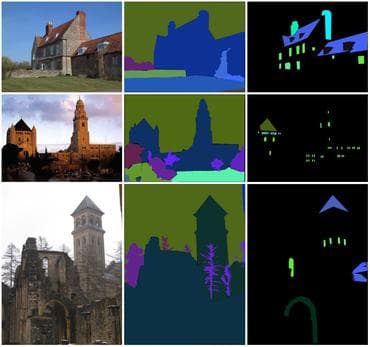
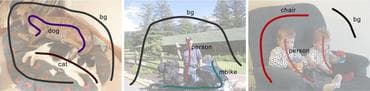
The semantic segmentation task is to assign a label from a label set to each pixel in an image. In the case of fully supervised setting, the dataset consists of images and their corresponding pixel-level class-specific annotations (expensive pixel-level annotations). However, in the weakly-supervised setting, the dataset consists of images and corresponding annotations that are relatively easy to obtain, such as tags/labels of objects present in the image. ( Image credit: Weakly-Supervised Semantic Segmentation Network with Deep Seeded Region Growing )
(Image credit: Papersgraph)

These leaderboards are used to track progress in weakly-supervised-semantic-segmentation-10
Use these libraries to find weakly-supervised-semantic-segmentation-10 models and implementations
No subtasks available.
IRNet is proposed, which estimates rough areas of individual instances and detects boundaries between different object classes and enables to assign instance labels to the seeds and to propagate them within the boundaries so that the entire areas of instances can be estimated accurately.
Puzzle-CAM, a process that minimizes differences between the features from separate patches and the whole image to discover the most integrated region in an object, can activate the overall region of an object using image-level supervision without requiring extra parameters.
An effective weakly supervised method containing two components to solve the problem of ineffective learning of network for large-scale point cloud semantic segmentation, and a sparse label propagation mechanism is proposed with the help of generated class prototypes which is used to measure the classification confidence of unlabeled point.
Expectation-Maximization (EM) methods for semantic image segmentation model training under weakly supervised and semi-supervised settings are developed and extensive experimental evaluation shows that the proposed techniques can learn models delivering competitive results on the challenging PASCAL VOC 2012 image segmentsation benchmark, while requiring significantly less annotation effort.
On the PASCAL VOC 2012 dataset, a DNN learned with segmentation labels generated by the method outperforms previous models trained with the same level of supervision, and is even as competitive as those relying on stronger supervision.
Object attention maps generated by image classifiers are usually used as priors for weakly-supervised segmentation approaches. However, normal image classifiers produce attention only at the most discriminative object parts, which limits the performance of weakly-supervised segmentation task. Therefore, how to effectively identify entire object regions in a weakly-supervised manner has always been a challenging and meaningful problem. We observe that the attention maps produced by a classification network continuously focus on different object parts during training. In order to accumulate the discovered different object parts, we propose an online attention accumulation (OAA) strategy which maintains a cumulative attention map for each target category in each training image so that the integral object regions can be gradually promoted as the training goes. These cumulative attention maps, in turn, serve as the pixel-level supervision, which can further assist the network in discovering more integral object regions. Our method (OAA) can be plugged into any classification network and progressively accumulate the discriminative regions into integral objects as the training process goes. Despite its simplicity, when applying the resulting attention maps to the weakly-supervised semantic segmentation task, our approach improves the existing state-of-the-art methods on the PASCAL VOC 2012 segmentation benchmark, achieving a mIoU score of 66.4% on the test set. Code is available at https://mmcheng.net/oaa/.
A self-supervised equivariant attention mechanism (SEAM) to discover additional supervision and narrow the gap between full and weak supervisions, and a pixel correlation module (PCM), which exploits context appearance information and refines the prediction of current pixel by its similar neighbors, leading to further improvement on CAMs consistency.
This paper addresses the value of cross-image semantic relations for comprehensive object pattern mining and provides a unified framework that handles well different WSSS settings, i.e., learning WSSD with (1) precise image-level supervision only, (2) extra simple single-label data, and (3) extra noisy web data.
This paper proposes SegGini, a weakly supervised segmentation method using graphs that can utilize weak multiplex annotations, i.e. inexact and incomplete annotations, to segment arbitrary and large images, scaling from tissue microarray to whole slide image (WSI).
Adding a benchmark result helps the community track progress.