3260 papers • 126 benchmarks • 313 datasets
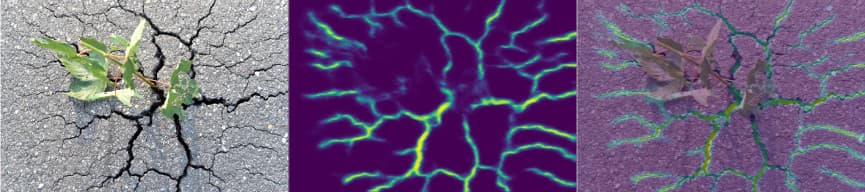
Crack segmentation in computer vision involves identifying and delineating cracks or fractures in various types of surfaces, such as roads, pavements, walls, or infrastructure. This task is crucial for infrastructure maintenance, as it helps in assessing the condition of structures and planning repairs.
(Image credit: Papersgraph)

These leaderboards are used to track progress in crack-segmentation-10
Use these libraries to find crack-segmentation-10 models and implementations
No subtasks available.
This paper combines previously available datasets and unifying the annotations by tackling the inherent problems within each dataset, such as noise and distortions, and presents a pipeline that combines Image Processing and Deep Learning models.
Current state-of-the-art semantic segmentation methods often apply high-resolution input to attain high performance, which brings large computation budgets and limits their applications on resource-constrained devices. In this paper, we propose a simple and flexible two-stream framework named Dual Super-Resolution Learning (DSRL) to effectively improve the segmentation accuracy without introducing extra computation costs. Specifically, the proposed method consists of three parts: Semantic Segmentation Super-Resolution (SSSR), Single Image Super-Resolution (SISR) and Feature Affinity (FA) module, which can keep high-resolution representations with low-resolution input while simultaneously reducing the model computation complexity. Moreover, it can be easily generalized to other tasks, e.g., human pose estimation. This simple yet effective method leads to strong representations and is evidenced by promising performance on both semantic segmentation and human pose estimation. Specifically, for semantic segmentation on CityScapes, we can achieve $\geq$2\% higher mIoU with similar FLOPs, and keep the performance with 70\% FLOPs. For human pose estimation, we can gain $\geq$2\% mAP with the same FLOPs and maintain mAP with $30\%$ fewer FLOPs. Code and models are available at \url{https://github.com/wanglixilinx/DSRL}.
This work forms the crack detection problem as a weakly-supervised problem and proposes a two-branched framework that is less affected by the annotation quality, and shows that the proposed framework retains high detection accuracy even when provided with low quality annotations.
Cracks are irregular line structures that are of interest in many computer vision applications. Crack detection (e.g., from pavement images) is a challenging task due to intensity in-homogeneity, topology complexity, low contrast and noisy background. The overall crack detection accuracy can be significantly affected by the detection performance on fine-grained cracks. In this work, we propose a Crack Transformer network (CrackFormer) for fine-grained crack detection. The CrackFormer is composed of novel attention modules in a SegNet-like encoder-decoder architecture. Specifically, it consists of novel self-attention modules with 1x1 convolutional kernels for efficient contextual information extraction across feature-channels, and efficient positional embedding to capture large receptive field contextual information for long range interactions. It also introduces new scaling-attention modules to combine outputs from the corresponding encoder and decoder blocks to suppress non-semantic features and sharpen semantic ones. The CrackFormer is trained and evaluated on three classical crack datasets. The experimental results show that the CrackFormer achieves the Optimal Dataset Scale (ODS) values of 0.871, 0.877 and 0.881, respectively, on the three datasets and outperforms the state-of-the-art methods.
This work proposes a weakly supervised approach that leverages a CNN classifier in a novel way to create surface crack pseudo labels that achieve comparable performance to fully supervised methods on four popular crack segmentation datasets.
A deep learning framework for crack detection based on classical network architectures including Alexnet, VGG, and Resnet is implemented and a hierarchical convolutional neural network (CNN)Deep learning framework which is efficient in crack segmentation is also proposed, and its performance is compared with other state-of-the-art network architecture.
This paper aims to improve the generalizability of deep learning-based methods by introducing a novel local intensity order transformation (LIOT), which transfers a gray-scale image into a contrast-invariant four-channel image based on the intensity order between each pixel and its nearby pixels along with the four (horizontal and vertical) directions.
This article proposes crack segmentation augmented by super-resolution (SR) with deep neural networks, and proposes two extra paths that further encourage the mutual optimization between SR and segmentation.
This paper builds a boundary guidance crack segmentation model (BGCrack) with targeted structures and modules, including a high frequency module, global information modeling module, joint optimization module, etc, to establish a unified and fair benchmark for the identification of steel cracks.
Adding a benchmark result helps the community track progress.