3260 papers • 126 benchmarks • 313 datasets
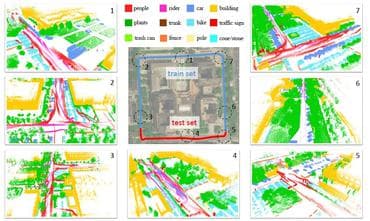
3D Semantic Segmentation is a computer vision task that involves dividing a 3D point cloud or 3D mesh into semantically meaningful parts or regions. The goal of 3D semantic segmentation is to identify and label different objects and parts within a 3D scene, which can be used for applications such as robotics, autonomous driving, and augmented reality.
(Image credit: Papersgraph)

These leaderboards are used to track progress in 3d-semantic-segmentation-10
Use these libraries to find 3d-semantic-segmentation-10 models and implementations
This paper designs a novel type of neural network that directly consumes point clouds, which well respects the permutation invariance of points in the input and provides a unified architecture for applications ranging from object classification, part segmentation, to scene semantic parsing.
A hierarchical neural network that applies PointNet recursively on a nested partitioning of the input point set and proposes novel set learning layers to adaptively combine features from multiple scales to learn deep point set features efficiently and robustly.
This work proposes SortNet, as part of the Point Transformer, which induces input permutation invariance by selecting points based on a learned score, to extract local and global features and relate both representations by introducing the local-global attention mechanism.
This work proposes a new neural network module suitable for CNN-based high-level tasks on point clouds, including classification and segmentation called EdgeConv, which acts on graphs dynamically computed in each layer of the network.
KPConv is a new design of point convolution, i.e. that operates on point clouds without any intermediate representation, that outperform state-of-the-art classification and segmentation approaches on several datasets.
An end-to-end pipeline called SqueezeSeg based on convolutional neural networks (CNN), which takes a transformed LiDAR point cloud as input and directly outputs a point-wise label map, which is then refined by a conditional random field (CRF) implemented as a recurrent layer.
This work creates an open-source auto-differentiation library for sparse tensors that provides extensive functions for high-dimensional convolutional neural networks and proposes the hybrid kernel, a special case of the generalized sparse convolution, and trilateral-stationary conditional random fields that enforce spatio-temporal consistency in the 7D space-time-chroma space.
This paper introduces RandLA-Net, an efficient and lightweight neural architecture to directly infer per-point semantics for large-scale point clouds, and introduces a novel local feature aggregation module to progressively increase the receptive field for each 3D point, thereby effectively preserving geometric details.
This work introduces new sparse convolutional operations that are designed to process spatially-sparse data more efficiently, and uses them to develop Spatially-Sparse Convolutional networks, which outperform all prior state-of-the-art models on two tasks involving semantic segmentation of 3D point clouds.
This work presents PartNet, a consistent, large-scale dataset of 3D objects annotated with fine-grained, instance-level, and hierarchical 3D part information, and proposes a baseline method for part instance segmentation that is superior performance over existing methods.
Adding a benchmark result helps the community track progress.