3260 papers • 126 benchmarks • 313 datasets
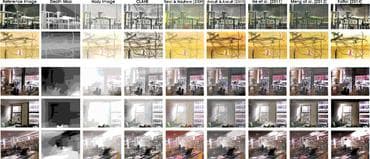
( Image credit: Densely Connected Pyramid Dehazing Network )
(Image credit: Papersgraph)

These leaderboards are used to track progress in image-dehazing-20
Use these libraries to find image-dehazing-20 models and implementations
No subtasks available.
This paper proposes a novel contrastive regularization (CR) built upon contrastive learning to exploit both the information of hazy images and clear images as negative and positive samples, respectively and develops a compact dehazing network based on autoencoder-like framework.
Experimental results on two real-world traffic prediction tasks demonstrate the superiority of GMAN, and in the 1 hour ahead prediction, GMAN outperforms state-of-the-art methods by up to 4% improvement in MAE measure.
This paper proposes a trainable end-to-end system called DehazeNet, for medium transmission estimation, which takes a hazy image as input, and outputs its medium transmission map that is subsequently used to recover a haze-free image via atmospheric scattering model.
This paper proposes an end-to-end generative method for image dehazing based on designing a fully convolutional neural network to recognize haze structures in input images and restore clear, haze-free images.
The proposed FFA-Net surpasses previous state-of-the-art single image dehazing methods by a very large margin both quantitatively and qualitatively, boosting the best published PSNR metric from 30.23 dB to 36.39 dB on the SOTS indoor test dataset.
This paper proposes an image dehazing model built with a convolutional neural network (CNN), called All-in-One Dehazing Network (AOD-Net), designed based on a re-formulated atmospheric scattering model that directly generates the clean image through a light-weight CNN.
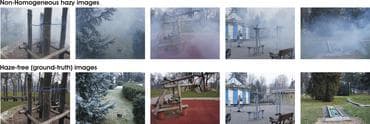
A new dataset -named I-HAZE- that contains 35 image pairs of hazy and corresponding haze-free (ground-truth) indoor images that allows us to objectively compare the existing image dehazing techniques using traditional image quality metrics such as PSNR and SSIM.
This paper proposes an end-to-end learning based approach which uses a modified conditional Generative Adversarial Network to directly remove haze from an image to demonstrate that the model performs competitively with the state of the art methods.
This paper presents an end-to-end network, called Cycle-Dehaze, for single image dehazing problem, which does not require pairs of hazy and corresponding ground truth images for training, and improves CycleGAN method both quantitatively and qualitatively.
Adding a benchmark result helps the community track progress.