3260 papers • 126 benchmarks • 313 datasets
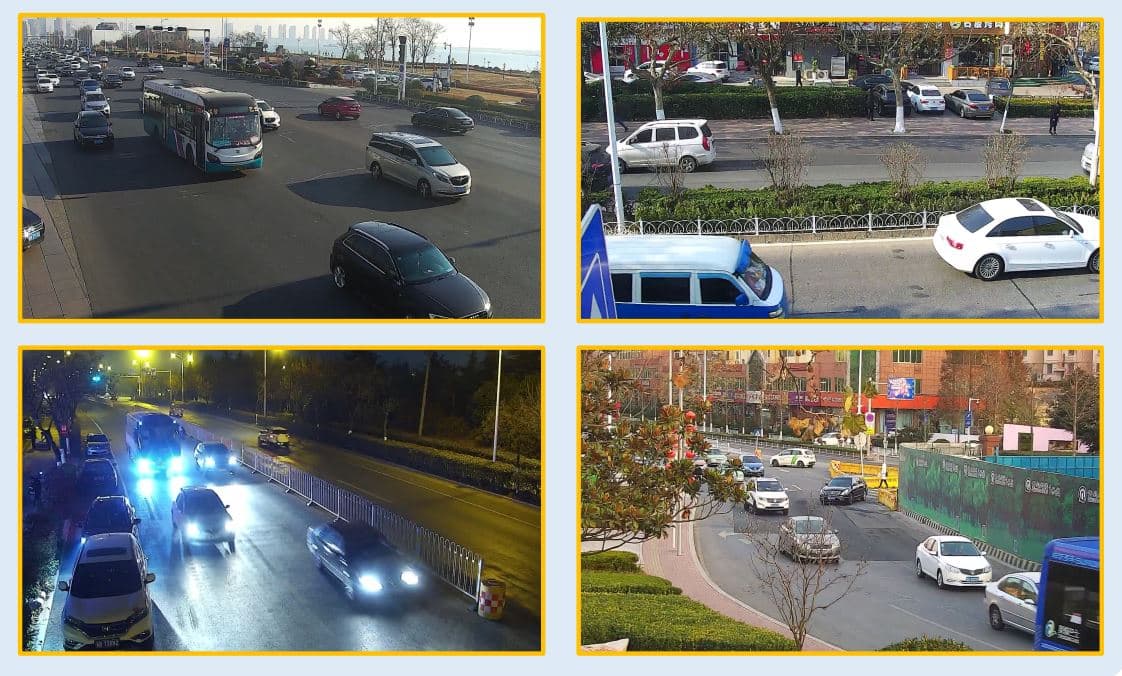
Vehicle re-identification is the task of identifying the same vehicle across multiple cameras. ( Image credit: A Two-Stream Siamese Neural Network for Vehicle Re-Identification by Using Non-Overlapping Cameras )
(Image credit: Papersgraph)

These leaderboards are used to track progress in vehicle-re-identification-2
Use these libraries to find vehicle-re-identification-2 models and implementations
No subtasks available.
A Pose-Aware Multi-Task Re-Identification (PAMTRI) framework that overcomes viewpoint-dependency by explicitly reasoning about vehicle pose and shape via keypoints, heatmaps and segments from pose estimation and achieves significant improvement over state-of-the-art on two mainstream vehicle ReID benchmarks.
This paper presents the solution to AICity Vehicle Re-id Challenge 2019, and builds a large-scale vehicle dataset called VehicleNet upon the public web data using the free data from the web and deploying the two-stage learning strategy.
This work presents FastReID as a widely used software system that supports single and multiple GPU servers, it can reproduce the project results very easily, and has implemented some state-of-the-art projects, including person re-id, partial re-ids, cross-domain re-ID, and vehicle re-identification.
This work first encode an image as a sequence of patches and build a transformer-based strong baseline with a few critical improvements, which achieves competitive results on several ReID benchmarks with CNN-based methods.
This work proposes to build a unique large-scale vehicle dataset by harnessing four public vehicle datasets, and design a simple yet effective two-stage progressive approach to learning more robust visual representation from VehicleNet.
Cluster Contrast employs a unique cluster representation to describe each cluster, resulting in a cluster-level memory dictionary, which can solve the problem of cluster inconsistency and be applicable to larger data sets.
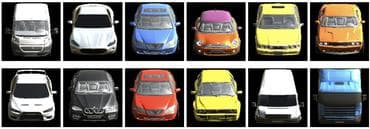
This paper introduces a large-scale synthetic dataset VehicleX, which contains 1,362 vehicles of various 3D models with fully editable attributes, and proposes an attribute descent approach to let VehicleX approximate the attributes in real-world datasets.
The Identity Mining method to automatically generate pseudo labels for a part of the testing data, which is better than the k-means clustering, is proposed and achieves third place in the AICITY20 competition.
Smooth-AP is a plug-and-play objective function that allows for end-to-end training of deep networks with a simple and elegant implementation and improves the performance over the state-of-the-art, especially for larger-scale datasets, thus demonstrating the effectiveness and scalability of Smooth-AP to real-world scenarios.
This work proposes a novel loss, namely Penalizing Negative instances before Positive ones (PNP), which can directly minimize the number of negative instances before each positive one and systematically investigates different gradient assignment solutions via constructing derivative functions of the loss.
Adding a benchmark result helps the community track progress.