3260 papers • 126 benchmarks • 313 datasets
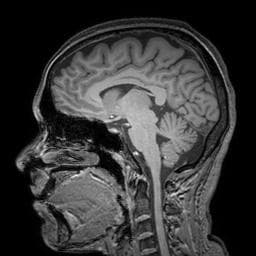
In its most basic form, MRI reconstruction consists in retrieving a complex-valued image from its under-sampled Fourier coefficients. Besides, it can be addressed as a encoder-decoder task, in which the normative model in the latent space will only capture the relevant information without noise or corruptions. Then, we decode the latent space in order to have a reconstructed MRI.
(Image credit: Papersgraph)

These leaderboards are used to track progress in mri-reconstruction-1
Use these libraries to find mri-reconstruction-1 models and implementations
The CIRIM showed highly promising generalization capabilities maintaining a very fair trade-off between reconstructed image quality and fast reconstruction times, which is crucial in the clinical workflow.
This paper presents a new approach to this problem that extends previously proposed variational methods by learning fully end-to-end and obtains new state-of-the-art results on the fastMRI dataset for both brain and knee MRIs.
This work trains a more powerful noise conditional score network by forming high-dimensional tensor as the network input at the training phase and estimates the target gradients in higher-dimensional space to tackle low-dimensional manifold and low data density region issues in generative density prior.
A new neural network, the XPDNet, for MRI reconstruction from periodically under-sampled multi-coil data is presented, which can achieve state-of-the-art reconstruction results, as shown by its ranking of second in the fastMRI 2020 challenge.
Convolutional Neural Networks (CNNs) are highly effective for image reconstruction problems. Typically, CNNs are trained on large amounts of training images. Recently, however, un-trained CNNs such as the Deep Image Prior and Deep Decoder have achieved excellent performance for image reconstruction problems such as denoising and inpainting, without using any training data—except leveraging a few samples for hyper-parameter tuning. Motivated by this development, we address the reconstruction problem arising in accelerated MRI with un-trained neural networks. We propose a highly optimized un-trained recovery approach based on a variation of the Deep Decoder and show that it significantly outperforms other un-trained methods, in particular sparsity-based classical compressed sensing methods and naive applications of un-trained neural networks in terms of reconstruction performance. We also compare performance (both in terms of reconstruction accuracy and computational cost) in an ideal setup for trained methods, specifically on the fastMRI dataset, where the training and test data come from the same distribution. Here, we find that our un-trained algorithm achieves similar performance to a baseline trained neural network, but a state-of-the-art trained network outperforms the un-trained one. Finally, we perform a comparison on a non-ideal setup where the train and test distributions are slightly different, and find that our un-trained method achieves similar performance to a state-of-the-art accelerated MRI reconstruction method.
This paper hosts the second fastMRI competition targeted towards reconstructing MR images with subsampled k-space data and identifies common failure modes across the submissions, highlighting areas of need for future research in the MRI reconstruction community.
This work presents a novel Deep Learning-based Inverse Problem solver applied to the task of Accelerated MRI Reconstruction, called the Recurrent Variational Network (RecurrentVarNet), by exploiting the properties of Convolutional Recurrent Neural Networks and unrolled algorithms for solving Inverse Problems.
A novel CS framework that permeates benefits from generative adversarial networks (GAN) to train a (low-dimensional) manifold of diagnostic-quality MR images from historical patients, which offers reconstruction under a few milliseconds, two orders of magnitude faster than state-of-the-art CS-MRI schemes.
It is shown that incorporating the proposed multiscale dictionary in an otherwise standard CSC framework yields performance competitive with state-of-the-art CNNs across a range of challenging inverse problems including CT and MRI reconstruction.
Adding a benchmark result helps the community track progress.