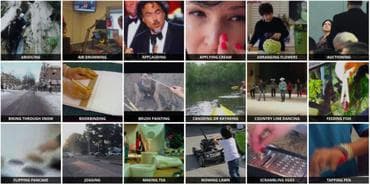
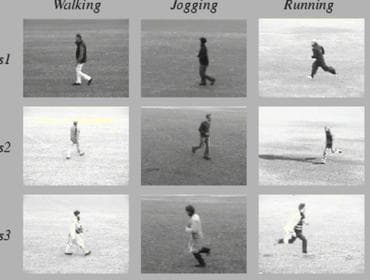
3260 papers • 126 benchmarks • 313 datasets
Please note some benchmarks may be located in the Action Classification or Video Classification tasks, e.g. Kinetics-400.
(Image credit: Papersgraph)

These leaderboards are used to track progress in action-recognition-1
Use these libraries to find action-recognition-1 models and implementations
Whether current video datasets have sufficient data for training very deep convolutional neural networks with spatio-temporal three-dimensional (3D) kernels is determined and it is believed that using deep 3D CNNs together with Kinetics will retrace the successful history of 2DCNNs and ImageNet, and stimulate advances in computer vision for videos.
I3D models considerably improve upon the state-of-the-art in action classification, reaching 80.2% on HMDB-51 and 97.9% on UCF-101 after pre-training on Kinetics, and a new Two-Stream Inflated 3D Conv net that is based on 2D ConvNet inflation is introduced.
This paper presents non-local operations as a generic family of building blocks for capturing long-range dependencies in computer vision and improves object detection/segmentation and pose estimation on the COCO suite of tasks.
A novel model of dynamic skeletons called Spatial-Temporal Graph Convolutional Networks (ST-GCN), which moves beyond the limitations of previous methods by automatically learning both the spatial and temporal patterns from data.
Deep convolutional networks have achieved great success for visual recognition in still images. However, for action recognition in videos, the advantage over traditional methods is not so evident. This paper aims to discover the principles to design effective ConvNet architectures for action recognition in videos and learn these models given limited training samples. Our first contribution is temporal segment network (TSN), a novel framework for video-based action recognition. which is based on the idea of long-range temporal structure modeling. It combines a sparse temporal sampling strategy and video-level supervision to enable efficient and effective learning using the whole action video. The other contribution is our study on a series of good practices in learning ConvNets on video data with the help of temporal segment network. Our approach obtains the state-the-of-art performance on the datasets of HMDB51 (\( 69.4\,\% \)) and UCF101 (\( 94.2\,\% \)). We also visualize the learned ConvNet models, which qualitatively demonstrates the effectiveness of temporal segment network and the proposed good practices (Models and code at https://github.com/yjxiong/temporal-segment-networks).
A novel paradigm for evaluating image descriptions that uses human consensus is proposed and a new automated metric that captures human judgment of consensus better than existing metrics across sentences generated by various sources is evaluated.
A new spatiotemporal convolutional block "R(2+1)D" is designed which produces CNNs that achieve results comparable or superior to the state-of-the-art on Sports-1M, Kinetics, UCF101, and HMDB51.
This work proposes an effective, efficient and end-to-end proposal generation method, named Boundary-Matching Network (BMN), which generates proposals with precise temporal boundaries as well as reliable confidence scores simultaneously, and can achieve state-of-the-art temporal action detection performance.
Adding a benchmark result helps the community track progress.